VIDEO
Together with E-Gaming Spain Online and Casino Gran Vía COMAR we analyse the rise of predictive markets: "They can be a breakthrough, not just a fad"
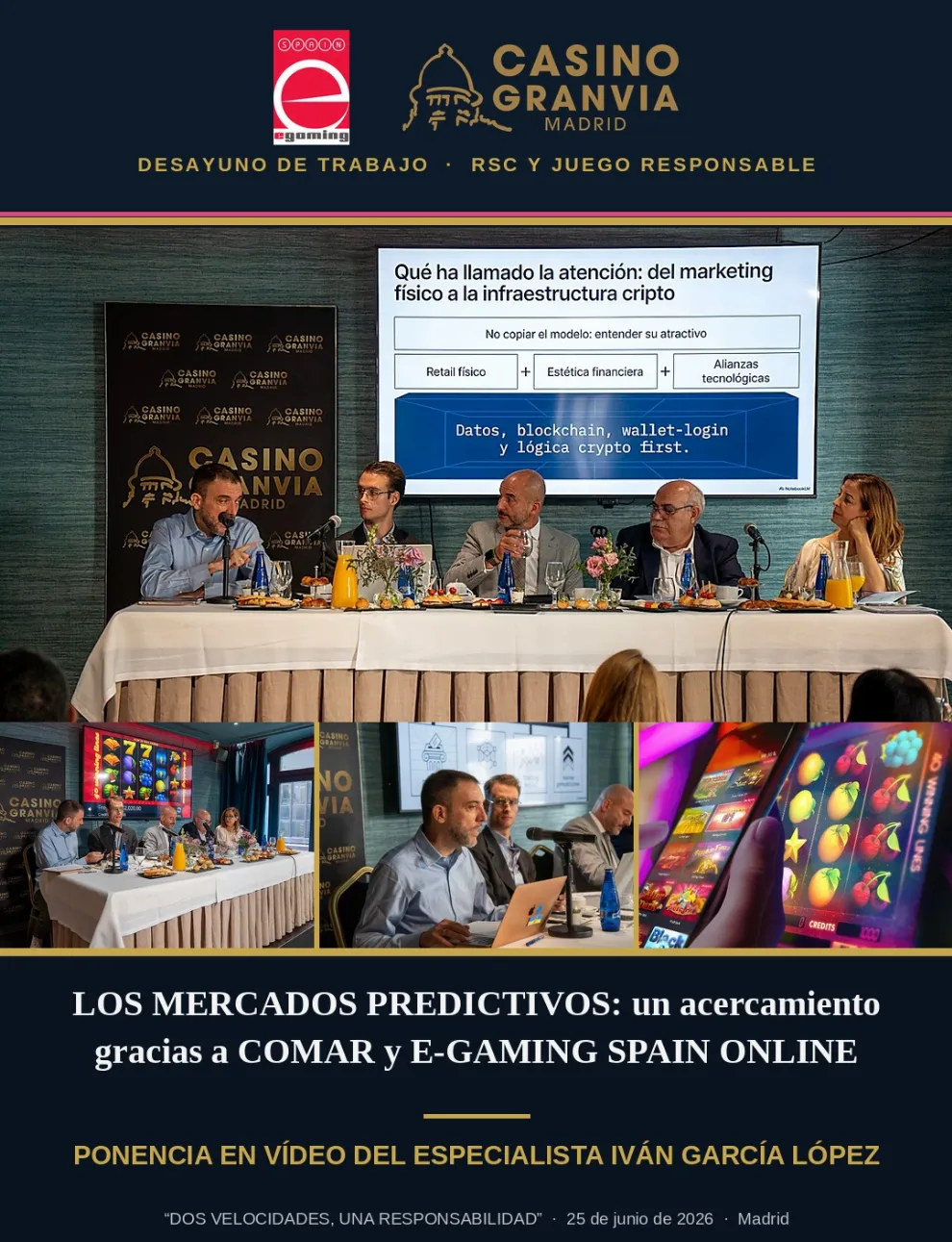
On 25 June, Casino Gran Vía COMAR hosted the CSR and Responsible Gambling Working Breakfast, “Two Speeds, One Responsibility”, organised by the Responsible Gambling and CSR Awards under the direction of Jacqueline Mecinas and sponsored by E-Gaming Spain Online. The gaming provider gave industry professionals the opportunity to gain first-hand insight into the growing phenomenon of prediction markets. Its CEO, Antonio Durán, opened and closed the event.
The session brought together representatives from public authorities, operators and suppliers, law enforcement agencies and industry associations. It was moderated by Ramón Cubián, Director General for Land Policy of the Community of Madrid and the official responsible for gambling management and regulation.
Alongside the presentation focused on prediction markets, the programme featured contributions from Jorge Hinojosa, President of Jdigital, and David Calvete, Head of the Gambling Control Service of Spain’s National Police, as well as a demonstration of the GMONITOR artificial intelligence platform.


The block of presentations began with the intervention of Iván García López, a specialist in online gaming and predictive markets, with experience in the sector since 2006 and linked since 2009 to a regulated operator in competitive intelligence tasks. Before the attendees, he presented a central thesis: predictive markets should not be read as a passing trend, but as a phenomenon with a real capacity to transform the gaming sector. To support it, he drew a parallel with the emergence of online poker in 2003, when the victory of an amateur player in the world championship of the discipline – classified through the internet – catapulted a vertical that ended up transforming the sector as a whole.
The speaker focused his analysis on Polymarket and Kalshi, the two US platforms that have been the protagonists of the growth of these products, sustained by high-investment advertising campaigns and by the support, as he explained, of Wall Street and Silicon Valley. García López stressed that Spanish and European regulations do not currently fit with this type of product as it is marketed in the United States, although he detected that regulated operators are already incorporating elements of their product and communication proposal.
As an example of the media reach of these markets, he cited the match between Spain and Cape Verde in the World Cup, in which the binary question about the Spanish victory generated a remarkable volume of bets and public repercussion, with monitoring even of the accounts of users who won or lost large amounts. He also exposed markets of a more extreme nature — from geopolitical issues to religiously tinged bets — as a sign of a "bet on everything" philosophy that, he warned, moves away from the principles that the regulated sector has historically defended.
The specialist pointed out several points of friction with the Spanish model: the absence of clear resolution mechanisms in ambiguous markets – he cited the case of a bet on Ukrainian President Volodymir Zelensky's clothing, with a volume of more than 60 million dollars and a questionable resolution – and the incompatibility with safeguards already in force in Spain. such as the limitation on live betting designed to avoid compulsive behaviour.
García López was explicit in differentiating these products from the counterparty betting license already existing in Spain, heir to Betfair's historic exchange product: although they share some elements, he stressed that they should not be equated, given that predictive markets operate under a peer-to-peer logic alien to the model of odds set by the operator.
In the question time, moderator Ramón Cubián asked if there was any study on the fit of these products in Spanish and European law, and on the risk that the economy of scale of these operators could displace the European regulated sector. García López replied that there is no way to fit into the current regulations today – with the exception of Malta and Gibraltar – and that, although he does not rule out regulatory, advertising and product frictions, leading operators in the United States such as FanDuel, DraftKings or Fanatics are already adapting their offer to incorporate markets of this type, which points to a coexistence by adaptation rather than a replacement of the traditional sports betting model.