EXCLUSIVE SPECIAL
The European experience marks the return of online poker in the United States

In the midst of a battle to integrate predictive markets into their offer, the two large multi-vertical operators in the United States are reactivating online poker with formulas that we already know well in European regulated markets: shared liquidity, live events and cost discipline.


For years, American online poker seemed doomed to occupy a secondary space in the face of the growth of sports betting and the casino. The reason?... that the regulation of online gambling advanced slowly, fragmented and very unevenly because, unlike European markets such as Spain, the United Kingdom or Italy, there is no single federal framework. Each state decides which modalities it authorizes – sports betting, online casino or poker – what taxes it applies and what requirements it requires of operators. In this context, without shared poker player liquidity, the priority was to develop the sports betting vertical, while traditional online poker also encountered stiff competition in the sweepstakes model, which boasted of offering the same gaming experience under the model of apparently recreational currencies and whose prizes, under certain conditions, could be exchanged for money
However, in 2026, the scenario is starting to change. DraftKings has recently entered the business with a network connecting three states, while Flutter has united PokerStars and FanDuel in a multi-product proposition where poker has gained enormous visibility.
We review the signs that after the seasonal boost of the World Series of Poker (WSOP) show us the renewed connection between the public and online poker, whose current elements remind us of several stages already traveled by European markets: sharing liquidity, integrating brands, being a gateway to other gaming products and learning to grow under increasing fiscal and regulatory pressure.
DraftKings and FanDuel put poker back at the center of strategy
The first sign of a boost for poker came on April 1. FanDuel launched PokerStars within the FanDuel brand in Michigan, New Jersey and Pennsylvania, connecting the liquidity of the three markets. The transaction brings together within Flutter two previously distinct assets: PokerStars' poker expertise and recognition and FanDuel's position in the US market (first in Daily Fantasy Sports and later in sports betting).
This change meant that from the point of view of product, sportsbook, casino and poker worked under the same wallet. It was also a movement that was already observed in Italy with the migration between SISAL and SNAI or in Ontario, where FanDuel and PokerStars also joined their paths; or the one that in a few days will take place in the UK and Ireland markets where PokerStars will be accessible from the Betfair gaming platform (it is expected that PaddyPower and SkyPoker will do the same by the end of the year). The objective in all these movements: to unify traffic and get more players.

The second came on July 8, when DraftKings activated its multistate poker network between Michigan, Pennsylvania and New Jersey. The Michigan Gaming Control Board confirmed five days later that it had authorized the operation after verifying compliance with regulatory requirements. DraftKings thus enters a vertical in which it had not had the presence it has built in sports betting and online casino.
The two moves are significant because poker is not regaining prominence through independent specialists, but within large gaming ecosystems; which represents a well-known logic in Europe, where large groups have been managing sportsbook, casino and poker for years as part of the same commercial relationship with the customer.
Shared liquidity: the US rediscovers a European lesson
The structural problem of regulated poker is simple as observed in markets such as France, Italy or Spain: if a roulette or online slots can work with one player; a poker table needs more players. The larger the available player base, the easier it is to offer a variety of limits, formats, prizes and schedules, reduce waiting times and build tournaments with attractive formats. That is why regulatory borders have especially visible commercial consequences for poker, such as the well-known exodus of Spanish poker players in 2012 when they emigrated to Portugal, the United Kingdom and other locations due to limitations on the number of players and tables in the new Spanish regulated market.
The United States is beginning to dismantle this obstacle through the Multi-State Internet Gaming Agreement (MSIGA). Michigan joined the agreement in 2022 and currently shares a framework with Delaware, Nevada, New Jersey, Pennsylvania and West Virginia. In any case, there is still a long way from a national market: participation continues to depend on the legislation and authorizations of each jurisdiction. But it does allow approved networks to combine players from several states.
What is MSIGA ? It is the acronym for Multi-State Internet Gaming Agreement: an agreement between several US states that allows online poker players to share liquidity with real money. Thus, people located in different member states can play at the same tables and tournaments. Delaware, Nevada, New Jersey, Michigan, West Virginia, and Pennsylvania currently participate. The union of these markets creates more players, available tables, and potentially larger prizes.
MSIGA is not a license nor does it automatically legalize online casinos throughout the United States. Only licensed operators can participate, and the player must be physically in a permitted state and pass geolocation checks.
Europe has already gone down a comparable trajectory and decided to unite its players on joint platforms. In July 2017, regulators in Spain, France, Italy and Portugal signed an agreement aimed at enabling shared liquidity between regulated operators, while maintaining national requirements for compliance, fraud prevention, player protection and anti-money laundering. Italy did not end up integrating operationally into the shared network, but Spain, France and Portugal did make progress.
A year after the launch, the Spanish, French and Portuguese regulators made a positive assessment. The Directorate General for the Regulation of Gambling pointed out in 2019 that shared tables and tournaments had become the predominant option over exclusively national ones. The lesson for the United States is not to copy the European legal architecture, but to recognize the same economic reality: regulating poker in compartments that are too small can protect an administrative border at the cost of weakening the product itself.
From the WSOP effect to satellites for Europe
Liquidity, however, needs content that mobilizes those players. June offered a demonstration. According to specialized media estimates, the six US states with regulated online poker generated approximately $9.3 million in revenue during the month, the highest level in eleven months. The WSOP Online brand (which uses 888.com software) and the celebration of the online version of the World Series within GGPoker, concentrated around 43% of the market, ten percentage points more than the previous month. FanDuel reached 26% and BetMGM 23%.
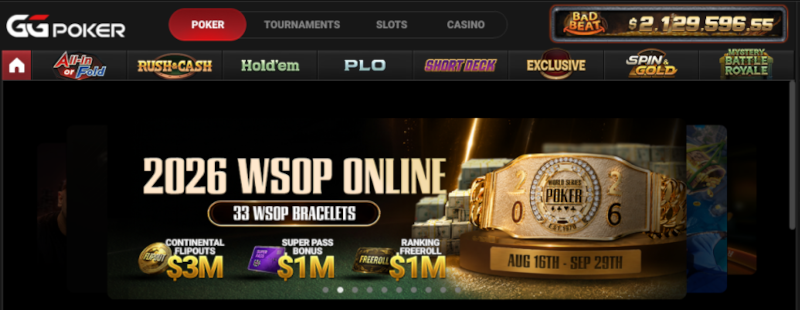
This is the so-called WSOP effect: the large face-to-face event in Las Vegas generates parallel activity on the internet and demonstrates the commercial value of connecting both channels.
PokerStars, already part of FanDuel, is exploiting this relationship between live and online from another direction. The company sponsors the Maryland State Poker Championship, (as it also does PokerStars.es with the Spanish Poker Championship) which will be held from August 26 to September 7 at Live! Casino & Hotel Maryland. The program includes 16 events and offers a direct connection to the PokerStars international circuit, the European Poker Tour. In fact, a participant of this local championship will be able to get a Player's Choice package for the European Poker Tour valued at 10,000 euros, including the entry of 5,300 euros to the Main Event, accommodation and travel expenses; which means greater visibility of the great annual poker party that PokerStars and Casino Barcelona organize in Barcelona on these dates.
This is another familiar practice for the European player: using satellites, regional festivals and online events as stepping stones to large land-based circuits. Poker is thus understood as an ecosystem and not as a collection of independent digital tables.
Profitability enters the equation
There is another similarity with mature European markets, although it affects the US online gambling business more broadly than poker specifically. Once the initial acquisition phase at any price is over, taxes and regulatory costs begin to condition promotions, pricing and marketing. Growth is no longer measured solely by volume and is now evaluated by its ability to generate profit margin for the operator. This greatly affects poker, which sees how in some states, offers for the player and guaranteed prizes are much more attractive than in others.
Illinois offers one of the clearest examples. The state replaced its flat 15% tax on sports betting in 2024 with a progressive structure that reached 40% for the largest operators. DraftKings then anticipated that one of the possible responses would be to reduce marketing spending. In 2025, Illinois also added an online betting tax that it again charged especially on higher-volume operators.
FanDuel decided to pass on that second cost through a surcharge of $0.50 per bet, a measure that its parent company Flutter explicitly linked to the new tax. DraftKings also adopted a partial pass-through mechanism: since September 2025 it applies $0.25 to certain Illinois bets, which go to 0.50 once 20 million wagers per year have been exceeded, although it establishes exceptions depending on the amount, type of bet and loyalty level.
It would not be rigorous to present these measures as a specific poker policy: they correspond mainly to the sports betting product. They do, however, reveal a relevant economic transformation for groups that manage several verticals. Europe has been showing for years that taxation, promotional restrictions and compliance costs end up influencing the value that an operator can dedicate to acquisition and retention. The same discipline is beginning to be visible in the United States. For poker, this reinforces the importance of liquidity and cross-selling: if acquiring players is more expensive, it is more valuable to get the same customer to find reasons to stay within the ecosystem.
CONCLUSION
The similarities allow us to speak of a certain Europeanization of American poker, but not of an exact reproduction of the model. Europe is not a single market either. Taxation, licensing, advertising and product continue to vary considerably between jurisdictions. Even the liquidity agreement signed by four regulators ended up materializing unevenly. The main lesson is precisely that regulatory cooperation can expand the market without eliminating national supervision.
The United States has an additional obstacle: its map continues to be extremely fragmented, with states where no online gambling is authorized and with a gray area that has been exploited by sweepstake projects and predictive markets such as Kalshi or Polymarket.
The creation of MSIGA, which connects poker players from certain states, the use by relevant players such as FanDuel of brands in its group such as PokerStars and the support of the land-based component (with the aforementioned connection to the EPT or the WSOP) show that although US poker will not return to the situation before 2011, it seems that this reconstruction is already underway.