Brazil: Supreme Court takes up case that will decide whether exploiting gaming machines is still a crime
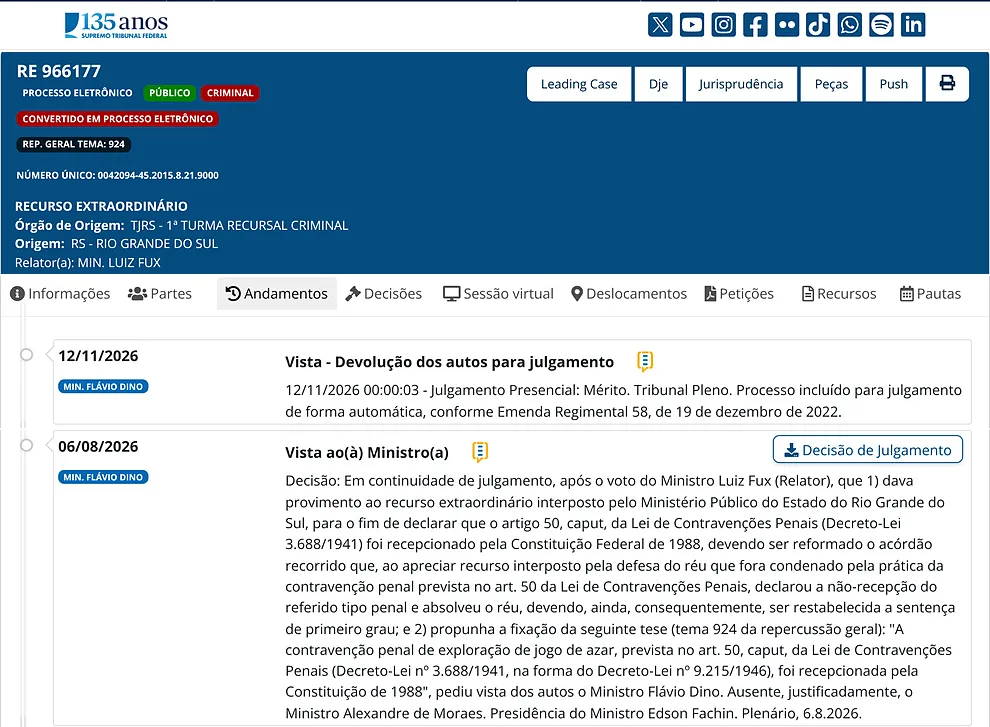
Official file of the Extraordinary Appeal 966177 in the Federal Supreme Court of Brazil, with the return of the file by Minister Flávio Dino on November 12.
Brazil's Supreme Federal Court has reactivated the trial on the 1941 law that prohibits gambling, with 2,728 cases awaiting. Minister Flávio Dino yesterday returned the file, which will be resolved together with the Betting Law.


The Federal Supreme Court of Brazil, the highest court in the country and the one that also resolves constitutional issues there, once again has on the table a matter that is of great interest to the sector. Yesterday, November 12, Minister Flávio Dino returned the Extraordinary Appeal 966177. The court's system has automatically included it for face-to-face trial in the Plenary, although it does not yet have a date.
What is at stake, pun intended, is whether Article 50 of the Criminal Contraventions Law of 1941 is still compatible with the Brazilian Constitution of 1988. That law punishes establishing or exploiting games of chance in public places or places accessible to the public with imprisonment of three months to one year and a fine. The case has general repercussions (Topic 924), so the doctrine established by the court will apply to all equal matters. According to the Supreme Court itself, there are at least 2,728 paralyzed processes in all instances awaiting this decision.
The case reached the Supreme Court through an appeal by the Rio Grande do Sul Prosecutor's Office against the acquittal of a person who operated machines in a bar in São Leopoldo. The court that acquitted her considered that, since the 1988 Constitution, exploiting games could no longer be treated as a contravention, because it clashed with the principle of individual freedoms.
The trial began on August 5. The next day, the rapporteur, Minister Luiz Fux, voted in favor of maintaining the rule. He proposed that the court declare that the contravention of exploitation of gambling "was received by the Constitution of 1988." In his speech, Fux spoke of a "structure of seduction" in gambling and warned that the inability of the player to measure the risks "can be increased and taken to the extreme by the mode of operation and functioning of betting, which requires redoubled attention from the public power and the State."
After that vote, Dino asked for a hearing, that is, more time to study the case. According to the official note of the Supreme Court, Dino agrees with the rapporteur that the prohibition is valid. But he wants the court's doctrine to also include online betting, because, in his words, it is not possible to talk about gambling without referring to gambling on internet platforms. The Plenary agreed by consensus to resolve the appeal along with other actions. Among them are direct actions of unconstitutionality 7721 and 7723, which question Law 14,790/2023, the law that regulated betting in Brazil.
And here the calendar of the machines intersects with that of betting. On November 3, Fux himself led a public hearing in the Supreme Court on the impact of the ban on online betting. He convened it as a result of Provisional Measure 1.394/2026, with which Lula's government banned the activity. According to the court, there are three actions of unconstitutionality against the Betting Law (7721, 7723 and 7749), and against the provisional measure, another four (8024, 8027, 8028 and 8035). If you want to review the origin of the ban, here we analyze to what extent Lula da Silva's veto of online gambling is credible.
The file of the machines is already ready for trial, although without a date, and the Plenary has promised to resolve it along with the actions against the Betting Law. At INFOPLAY we will closely follow when the Supreme Court of Brazil sets a date for a ruling that may change the rules of the game in the country.