The international association warns that contracts on sports results are not a "gray area" but an activity that must be subject to regulation, integrity control, and consumer protection.
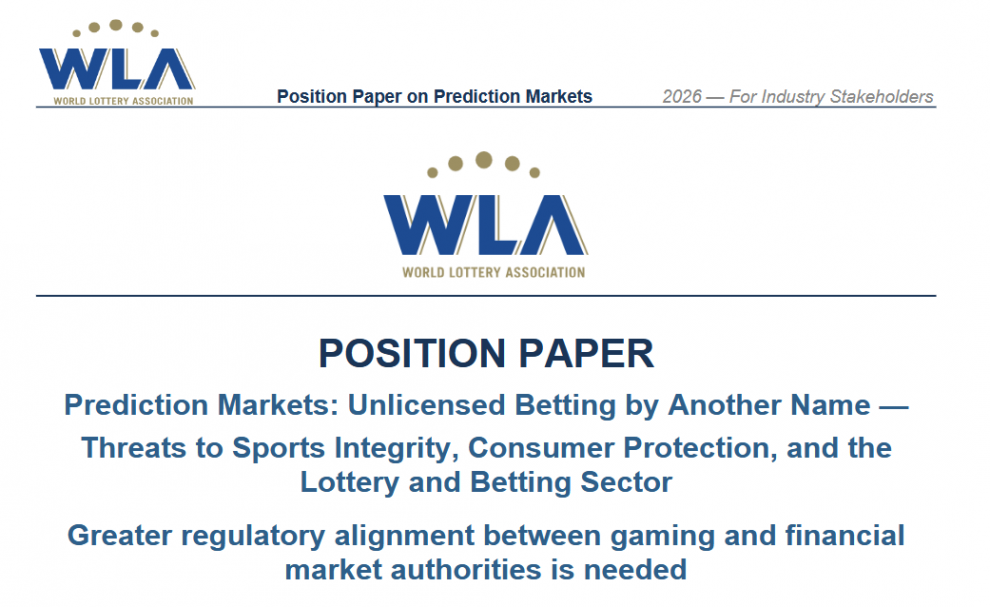
The World Lottery Association (WLA) has taken a strong stance against the growth of so-called prediction markets, which are platforms that allow users to trade financial contracts linked to the outcome of sports or other events. In a position paper addressed to industry stakeholders, the organization argues that when these products accept money from consumers in exchange for a financial return conditioned on an event's outcome, they must be functionally treated as betting or regulated gaming.
The WLA rejects the notion that this phenomenon can be described as a simple matter of innovation or a philosophical debate on new market models. For the organization, the issue is much more concrete: operators using a financial label may be offering products equivalent to betting without undergoing the obligations fulfilled by licensed operators.
The document underscores that regulators should adopt a functional definition of sports betting and events subject to wagering. This ensures that contracts on sports results or other events are included, regardless of the commercial or legal name used by the platform.
Among its main recommendations, the WLA calls on governments and regulatory authorities to require a gaming or betting license from any entity offering event-based financial contracts before starting operations in each jurisdiction. It also demands the enforcement of existing obligations against unauthorized operators, including measures like geoblocking, orders to internet service providers, and, where appropriate, actions against corporate officials.
Furthermore, the organization positions the Macolin Convention as a key tool to address sports integrity risks. In this regard, it urges states to ratify and fully implement it, explicitly incorporating unauthorized sports event contract platforms into its scope of action.
Consumer protection is another pillar of the document. The WLA considers it essential to extend national self-exclusion registries, responsible gaming tools, and support frameworks against problem gambling to prediction market platforms operating within a jurisdiction.
The association also addresses sports bodies and integrity entities, asking them to include these platforms in monitoring systems, information-sharing agreements, and suspicious activity reporting obligations. Additionally, it recommends incorporating specific restrictions into the codes of conduct for athletes, officials, and support personnel, particularly due to the risks of insider information usage.
For regulated operators, the WLA sends a clear message: support a level playing field, collaborate with authorities by providing data and intelligence, and avoid the temptation to adopt prediction market models that could weaken the regulatory framework. When a licensed operator enters this segment, the organization requests that it apply the same standards of responsible gaming, self-exclusion, and integrity as it does for its core products.
The position paper warns that the growth of this activity has been rapid, reaching an estimated annual volume of over $60 billion in just two years. For the WLA, this expansion does not alter the legal nature of the problem but rather reinforces the urgency for a coordinated, proportional, and effective response.
The organization concludes that the regulated lottery and betting industry holds a decisive advantage over these models: trust. According to the document, a 2026 study by Lotto Research places player trust in loterías at 83%, compared to 40% for FanDuel and 38% for DraftKings.
The WLA insists that consumer protection and sports integrity "are non-negotiable" and warns that the regulated sector cannot fulfill its public interest role if it must compete against a parallel, unauthorized, unmonitored industry that lacks the same regulatory responsibilities.
18+ | Juegoseguro.es - Jugarbien.es