We exclusively publish the Game and Society 2026 report: 31 million players, 77.5% in the National Lottery and 18.4% in casinos, bingo halls, lounges and betting
Infoplay offers the seventeenth edition of the study on Spaniards' gambling habits in its entirety.


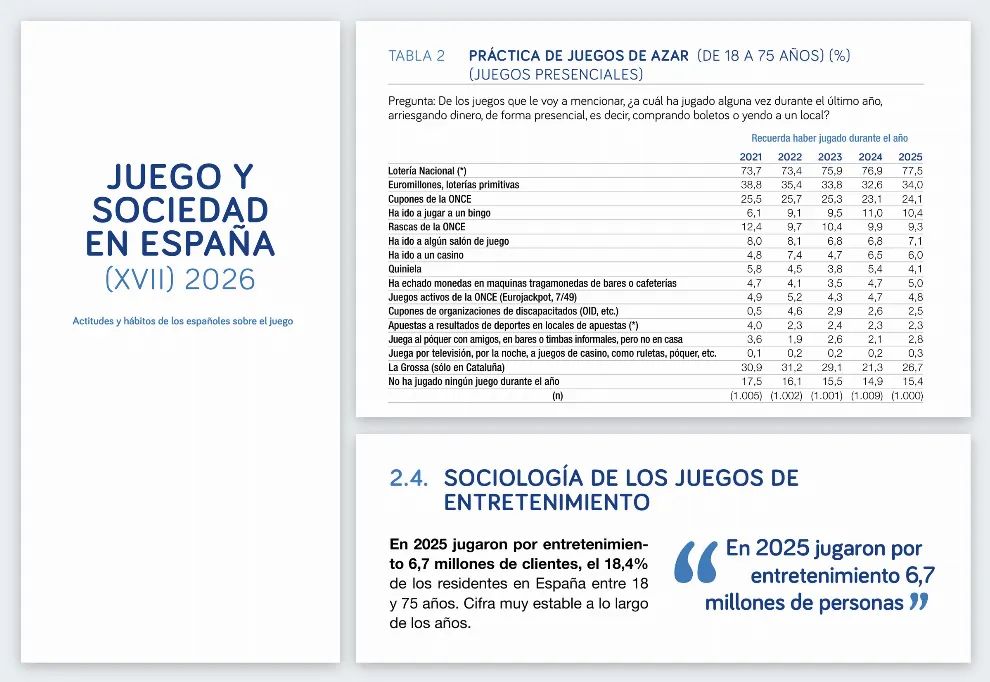
After yesterday's great information display around the I CEJUEGO Forum, Infoplay exclusively publishes the full report Game and Society in Spain (XVII) 2026. Published by the Gambling Business Council (CEJUEGO), the study analyzes the attitudes and habits of Spaniards towards gambling and its readers can consult it in full.
The report is directed by the sociologist José Antonio Gómez Yáñez, PhD in Sociology from the Carlos III University, in collaboration with the lawyer Carlos Lalanda, founder of Loyra Abogados. The fieldwork has been carried out by IMOP Insights. Among its main conclusions, the study estimates that 31 million Spaniards gambled in 2025 and places gambling disorder at 0.3% of the population.
In 2025, 31.0 million residents in Spain between the ages of 18 and 75 played. Of these, 6.5 million played in face-to-face entertainment games and 2.2 million in online games.
Lotteries continue to dominate. The Christmas Lottery exceeds 26 million buyers and El Niño 14 million; both draws are, according to the study, authentic national events. The primitive lotteries are close to 12.5 million players.
Casinos, bingo halls, gaming halls, betting and arcade machines in the hospitality industry each move between two and three million customers per year. In all of them there is a core of regular players and a large group of occasional customers. In 2025 figures, 3.8 million went to bingo, 2.6 million to a gaming hall and 2.2 million to a casino, while 1.8 million played machines in bars and cafes.
Only nearly six million residents played nothing in 2025.
The report underlines the social dimension of gambling. For its customers, playing for entertainment "is equivalent to paying a ticket to a show": you play to pass the time, comment on the play and share time with friends or people with the same hobby, always with a controlled expense. In the words of the study, "entertainment games are made of time, knowledge and relationship" with those who share a hobby, "not greed".
The study also notes a slow decline in the regularity of the game, at a speed that it defines as "almost geological". Those who play daily, several times a week or every week add up to 15%, while those who play only occasionally reach 50%.
Online gambling maintained its growth line in 2025, although in limited percentages of the population:
Gambling disorder remains at 0.3% of the population aged 18 to 75. The diagnosed disorder drops to 0.024%, 3.3% of the population diagnosed with addictions, with 7,896/7,931 cases according to the latest Report of the National Plan on Drugs. With these data, Spain is among the seven countries with the lowest rate of problem gambling in those compared, at the level of England (0.3%) and below France, Germany or Italy.
According to the psychiatric studies cited in the report, 85% of these cases have other behavioral disorders, and gambling is not their trigger.
From there, the study proposes that prevention policies should be oriented towards precision actions aimed at specific risk profiles, instead of extensive campaigns towards broad sectors such as young people or women, which can be "dispersed and imprecise" and even have "counterproductive effects". The design of these policies, it concludes, must be based on "a correct diagnosis of a very limited problem in its dimension".
Juego y Sociedad reaches its seventeenth edition and has established itself as a reference for understanding the gaming market in Spain, as reflected in the 2024 and 2025 presentations.