WE ANALYZE: The major milestones of the Platform for Sustainable Gambling in its 2025-2026 Annual Report
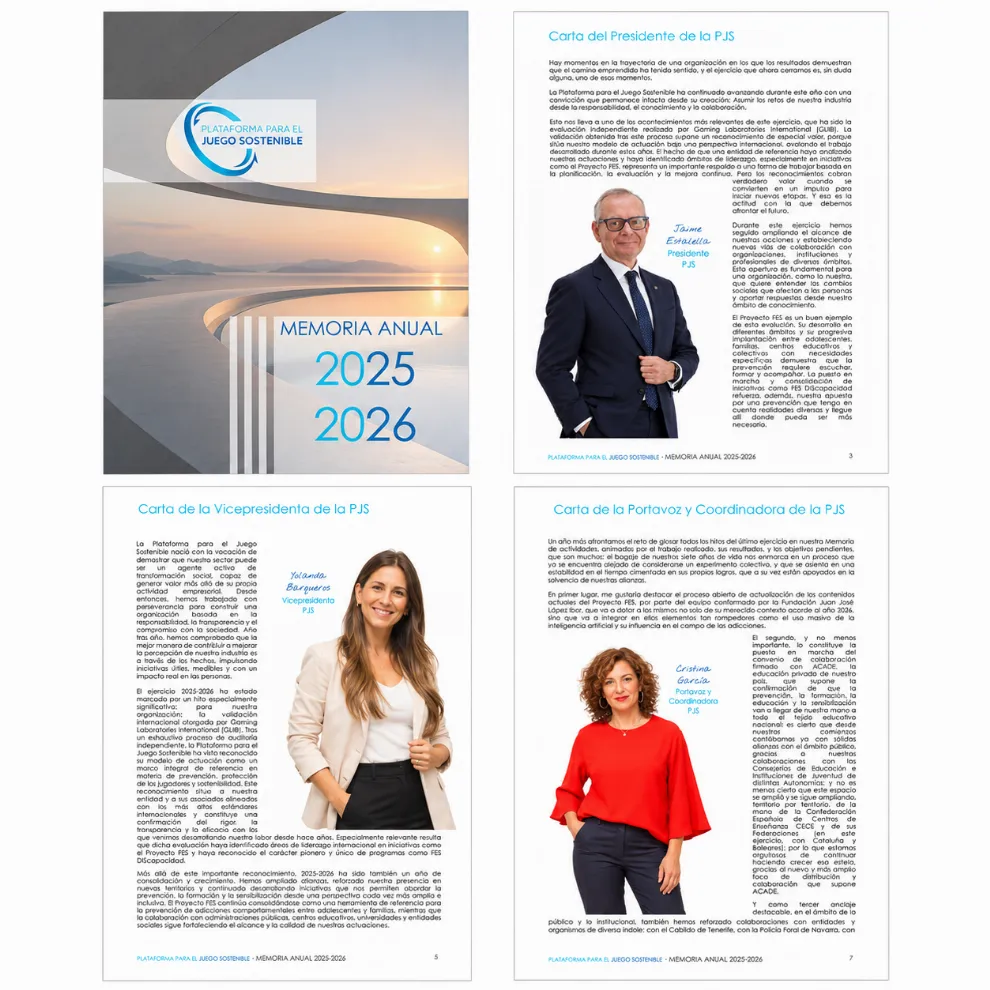
The international validation of GLI, the incorporation of artificial intelligence into the FES Project content, the expansion of educational alliances, and the entry of new partners are the focus of the 96 pages of the 2025-2026 Annual Report of the Platform for Sustainable Gambling. A document that deserves special attention from entrepreneurs in the Spanish gambling industry.


Seven years of history, 21 associated entities, and a model of collective corporate social responsibility that, according to the new report, matches or surpasses the best international practices in responsible gaming. The Platform for Sustainable Gambling presents a balance highlighting its ability to establish partnerships with public, educational, scientific, and social institutions, transcending the boundaries of the industry itself.
The first pages of the document gather the reflections of the three main leaders of the entity. Jaime Estalella, president of the Platform, highlights the value of GLI's independent evaluation and expressly acknowledges Cristina García's dedication and coordination skills, which are crucial in turning the organization's objectives into concrete initiatives.
"Trust is not built with declarations, but with transparency, with actions, and with a permanent will to do things better," says Estalella.
For her part, Yolanda Barqueros, vice president, emphasizes the sector's ability to generate value beyond its own business activity and highlights the pioneering nature of FES DIScapacidad. "We have managed to turn commitments into actions and ideas into projects capable of generating a positive and tangible impact on society."
Cristina García, spokesperson and coordinator, highlights the strength of the alliances established over these seven years and the growing credibility of the industry as a collaborator of institutions and organizations from other areas of society.
The validation of Gaming Laboratories International marks the major international milestone of the exercise. The independent audit examined twelve areas of action related to institutional relations, communication, recognitions, territorial implementation of the FES Project, collaboration agreements, university alliances, prevention among people with disabilities, collaboration with family and health organizations, sports integrity, research, and ambassador participation.
According to the report, GLI concluded that the model developed by the Platform matches or surpasses the best international practices in responsible gaming, identifying areas of leadership in the FES Project and recognizing the pioneering role of FES DIScapacidad.
The awarding of the Responsible Gaming Seals to members also represents an individualized recognition of the commitment of the companies that have contributed to building this collective project.
One of the most widely publicized new features is the one announced by Cristina García in her cover letter. The Juan José López-Ibor Foundation is working on updating the contents of the FES Project to adapt it to new technological challenges, incorporating the massive use of artificial intelligence and its influence in the field of addictions.
Currently, the project has three major programs. The first is dedicated to the primary prevention of behavioral addictions among adolescents, families, and the educational community; FES DISability develops tools adapted to the needs of people with disabilities, especially in special employment centers; and FES INTegridad promotes fair play, transparency, and sports ethics.
This latest initiative also includes the use of artificial intelligence tools to detect and prevent irregular conduct in sports competitions and betting, as well as addressing issues such as match-fixing, doping, and sports fraud.
Of particular importance is the agreement with ACADE, which opens new possibilities to extend the contents of the FES Project among Spanish private education centers.
This collaboration complements the alliances that the Platform already maintains with the Education departments, the regional youth institutions, and the Spanish Confederation of Educational Centers (CECE), whose federations from Catalonia and the Balearic Islands have led new actions during the year.
The organization has also strengthened its relationships with the Tenerife Island Council, the Navarre Provincial Police, and the Mental Health Forum of the Ortega-Marañón Foundation, in addition to approaching the journalistic field through its participation in the 7th National Journalism Course of Alcañiz.
The expansion of these alliances is one of the main assets of the Platform, as it allows an initiative born from the gaming industry to find interlocutors and collaborators in strategic sectors of Spanish society.
The report dedicates a specific chapter to contextualizing the economic weight of the Spanish gaming industry. According to CEJUEGO data for 2024, real gaming — amounts played minus prizes — reached 11,888 million euros, equivalent to 0.78% of GDP.
Private gambling represents 54.1% of the market, compared to 45.9% of public gambling. In-person private activity reaches 4,945 million euros, while the online channel stands at 1,489 million. Meanwhile, SELAE records 4,140 million and ONCE, 1,253 million.
In fiscal matters, the document estimates the contribution of private gaming at 1,857 million euros, of which 1,214 million correspond to taxes and special fees on gambling and 643 million to common taxes on private in-person gambling.
The report also places reinvestment in R+D+i between 10% and 15% of business volume and includes an investment of two million euros annually in industrial and electronic waste management.
The human factor occupies a prominent place in the document. The Spanish private gambling sector is made up of more than 5,000 companies, the vast majority of them family-run SMEs, alongside multinational companies.
Private activity generates 46,287 direct jobs, while the gaming sector as a whole generates another 175,000 indirect jobs, according to figures collected in the report.
Particularly interesting is the figure regarding wage compensation in the industrial area, which is 26.2% above the average of manufacturing industry, due to its high degree of specialization.
The Platform also highlights the diversity of professional profiles demanded by the sector, from engineers, mathematicians, programmers, and designers to technicians, administrative staff, and customer service professionals, with female participation around 55%.
The report incorporates the estimates from the Gambling and Society in Spain 2026 report, published by CEJUEGO, which places 0.3% of the Spanish population aged 18 to 75 as the category with the highest severity of problem gambling.
Regarding gambling disorder treated in healthcare services, the document records an approximate figure of 8,000 people annually, corresponding to 2023 data and equivalent to 0.024% of the population in that age group.
The Platform emphasizes the importance of designing public policies based on scientific evidence, taking into account psychological, family, genetic, neurobiological, and social factors related to the development of addictions.
DEGESTEC GAMES, AZULRED, and ASENSI ABOGADOS have joined the Platform for Sustainable Gaming during the fiscal year.
The report currently brings together 21 entities: ACORDJOC, ANMARE, ARISTOCRAT, ASENSI ABOGADOS, AZULRED, BARIANZA, DEGESTEC GAMES, EGT, FEMURE, GRUPO JUAN PADRÓN, GRUPO KIROL, GRUPO MARINOCIO, GRUPO MAS, GRUPO MATENCIO, MERKUR DOSNIHA, NOVOMATIC SPAIN, GRUPO RETABET, SAREIBA, GRUPO VERAMATIC/JOKERBET, GRUPO VID/PAUSE & PLAY, and ZITRO.
The final part of the document dedicates ample space to individual corporate social responsibility initiatives of its members, giving visibility to business work in environmental sustainability, inclusion, employment, training, volunteering, and responsible gaming.
The 2025-2026 Annual Report ultimately offers a perspective on the scale the Platform has acquired in its seven years of existence. A collective project that has managed to incorporate collaboration with institutions of recognized prestige into its social responsibility strategy and that now finds, in the international validation of GLI, significant support to continue advancing.
DOWNLOAD THE COMPLETE ANNUAL REPORT 2025-2026