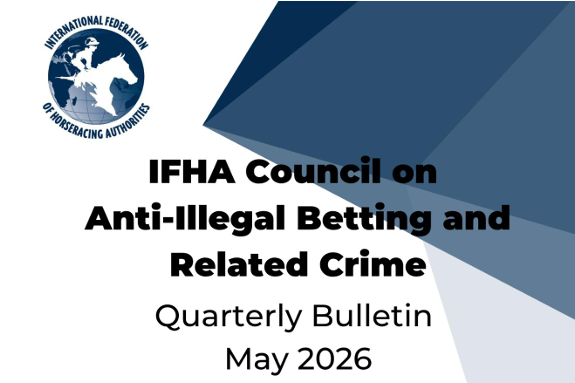
The Council on Anti-Illegal Betting and Related Crime of the International Federation of Horseracing Authorities (IFHA) has published its quarterly bulletin for May 2026. The document analyzes the structural impact of expanding betting activities on sports integrity, corruption networks in cricket, and the existential threat that the black market poses to the financing of horse racing.
The latest IFHA report addresses globally how the rapid evolution of the betting economy, both regulated and clandestine, is transforming contemporary sports with still insufficient institutional oversight. Council experts agree that the sector faces technological and ethical challenges that demand a coordinated transnational response.
Growing dependence on betting and athlete vulnerability
Professor Pim Verschuuren analyzes the impact of the profound mutation that sports are undergoing due to their increasingly tight economic links with the gambling industry. Commercial alliances of enormous magnitude prove this: during the 2024/2025 season, 66% of clubs in the top football divisions of the EU and the United Kingdom had sponsorships with betting companies. The risk worsens when illegal operators (such as the case of 1XBet and PSG) manage to infiltrate to whitewash their reputation before the public.
This omnipresence of gambling stimuli directly impacts the mental health and integrity of athletes:
- An NCAA study (2025-2026) revealed that a third of college athletes suffered physical or virtual abuse from bettors who blamed them for their financial losses.
- An increase in gambling addiction is noted among athletes across all disciplines, including women's categories and para-sports.
- To prevent athletes themselves from betting, countries like France, Belgium, Spain, and Italy already apply automated cross-checking systems for racing and sports licensing data, a tool successfully implemented at Paris 2024 and Milano-Cortina 2026.
Cricket at the crossroads of the black market
Jacqui Partridge and Michael Angel (Cricket Australia) expose how mobile app betting and real-time data access have triggered match-manipulation risks, especially through "micro-events" (individual actions that are very difficult to detect and do not alter the final result).
The problem lies in unregulated offshore Asian markets (in India, it is estimated that between 80% and 90% of sports betting is directed at cricket). Lacking integrity contracts or federation oversight, these operators allow betting on amateur categories, offer anonymity via cryptocurrencies, and serve as a channel for organized crime. The authors recall recent cases of player suspensions (such as Praveen Jayawickrama or Devon Thomas) for merely delaying or failing to report match-fixing offers, which constitutes a serious violation under the Anti-Corruption Code.
Horse racing: An economic model under threat
The Chairman of the IFHA Council, Martin Purbrick, highlights that horse racing suffers the impact of illegal operators much more severely than other sports. While other disciplines view betting as a secondary revenue stream (sponsorships), the financial viability of horse racing (prize money, infrastructure, and integrity programs) depends directly on exploitation fees, racing levies, and totalisator returns from legal gambling. Every bet diverted to the illegal market directly erodes the funding of the activity.
The report details the diversity of international funding models (from the unified monopoly of the Hong Kong Jockey Club or the pari-mutuel system of the French PMU, to the regulated commercial frameworks of the United Kingdom and Australia). However, they all share the same weakness: overly restrictive local regulations or high tax burdens reduce the competitiveness of the legal market, pushing users toward clandestine platforms that offer better odds. IFHA Chairman Winfried Engelbrecht-Bresges warns that the illegal market is massively attracting young people aged 18 to 25 through multi-million dollar marketing campaigns, compromising the generational renewal of the legal customer base.
Strategic recommendations from the Council
To curb the expansion of illegal gambling, the IFHA Council proposes a multi-stakeholder approach:
- Implement the Macolin Convention: Urge governments worldwide to ratify this Council of Europe convention, which provides the ideal legal framework against match manipulation and promotes national cooperation platforms.
- Financial and ISP blockings: Compel internet service providers to block clandestine portals and coordinate with banking institutions to freeze transactions toward unlicensed operators.
- Sports data protection: Develop strategies to prevent live data siphoning, stopping illegal platforms from using live information feeds and odds from regulated races for free.
- Responsibility of data providers: Demand that multinational sports data companies market their information exclusively to operators with valid licenses in the destination jurisdictions.
READ THE FULL REPORT
18+ | Juegoseguro.es – Jugarbien.es