Veikkaus returns to the path of growth in the first half of 2026 and accelerates its preparation for the opening of the Finnish market
The Finnish state-owned operator raised its sales revenue to €471.3 million and its profit for the period to €234.2 million, driven by the digital business, while finalising the leap to a licensing system that will come into force on 1 July 2027.


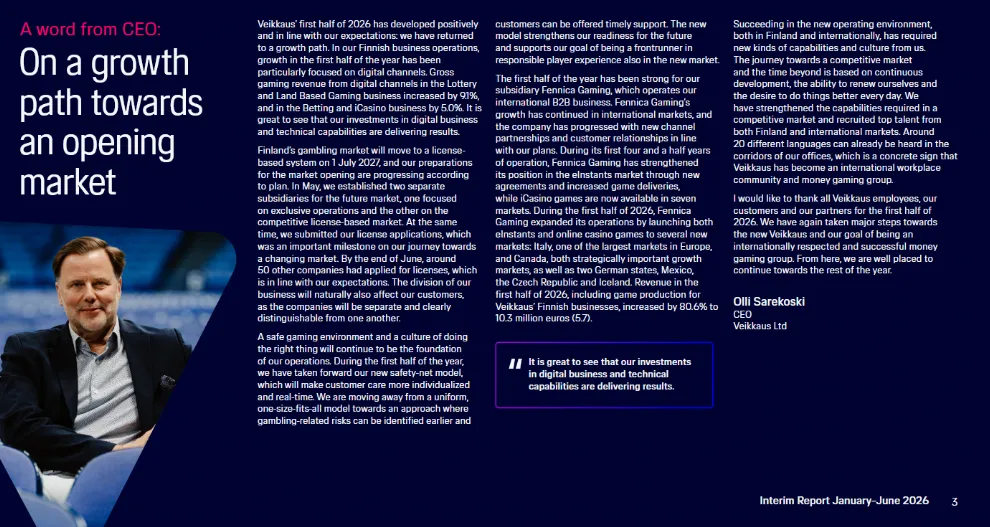
Veikkaus, Finland's public gambling company, closed the first half of 2026 with a return to growth and progress "as planned" in its transition to an open market. This is reflected in its half-yearly report (January–June 2026), in which CEO Olli Sarekoski stresses that the first half of the year "has developed positively and in line with expectations".
The Veikkaus Group – made up of parent company Veikkaus Ltd and international subsidiary Fennica Gaming – achieved sales revenue of €471.3 million between January and June 2026, compared to €466.4 million in the same period of 2025, an increase of 1.0%. This figure includes both gross gaming revenue and turnover from other activities.
The Group's operating profit stood at €227.7 million (€220.6 million in the previous year), while profit for the period amounted to €234.2 million (€ 229.6), an increase of 2.0%. The company attributes the positive impact on both revenues and net profit to the growth of the digital business.
The revenue of parent company Veikkaus Ltd from the gaming activity (gross revenue) was €469.5 million (€463.9). Its operating profit fell to €227.3 million (€242.7) and financial profit to €238.9 million (€250.5); however, the result for the 2025 comparison period included a non-recurring income of €20.7 million recorded by the gaming studio's internal activity. The company paid the State a total of €56.1 million in lottery tax, €0.9 million more than a year earlier.
At the end of the period, the Group's cash and cash equivalents amounted to €353.9 million, with liquidity "at a good level", and the total balance sheet reached €503.3 million.
The Finnish business was the big driver of growth, driven by digital channels. Gross revenues from the digital channel grew by 9.1% in the Lottery and Land Based Gaming area and by 5.0% in the Betting and iCasino business. "It's great to see that our investments in the digital business and technical capabilities are paying off," says Sarekoski.
In the first half of the year, 64.5% of Veikkaus Ltd's gross revenue came from the digital channel and 35.5% from physical points of sale, with an increase of 3.6 percentage points in the digital weight. At the end of June, the company had 2,672,000 registered customers, about 50,000 more than a year earlier. In the Finnish market, the Lottery and Land-Based Gaming business accounts for 67.7% of gaming revenues, and the Betting and iCasino business, 32.3%.
In Lottery and Land-Based Gaming, gross revenue was €317.9 million (€317.5). Lottery games contributed €254.5 million (€246.1), with sustained growth in the digital channel – especially through the Veikkaus app – supported by the Milli game (launched in June 2025) and higher Lotto jackpots than in the comparison period. On the other hand, slot machines and land-based table games fell to €63.4 million (€71.3), mainly due to the contraction of the retail network and the consequent reduction in the number of machines. New games were launched on a monthly basis during the first half of the year, with the most popular being Metsän kuningas (January) and Kulta-Jaska: Kaivoksen kulta (June).
In Betting and iCasino, gross revenue grew to €151.6 million (€146.5 million), with particularly positive development in digital channels and a record number of customers. iCasino had a strong first half of the year: the offer was expanded with new games and providers, the launch capacity of Veikkaus' in-house studio was doubled and Live Casino continued to grow rapidly. Betting also performed strongly, both in sports betting and Toto games, supported by major events such as the Olympic Games, the Ice Hockey World Championship and the start of the FIFA World Cup. Fixed-odds betting grew strongly in the digital channel, while point-of-sale gambling continued to decline.
The subsidiary Fennica Gaming, in charge of the international B2B business, made one of the big headlines of the semester. Its revenues – including the production of games for Veikkaus' Finnish businesses – increased by 80.6% to €10.3 million (€ 5.7 million in the previous year). The 2025 comparison figure did not include revenue from Finnish businesses prior to the transfer of the game studio in early April.
During the first half of 2026, Fennica Gaming made relevant launches in Italy – the largest lottery market in Europe and one of the largest regulated gambling markets on the continent – and in Canada, considered strategic for the expansion of online gambling in its provinces. In addition, the company entered two German states, Mexico, the Czech Republic and Iceland. Its eInstants business continued to grow with new deals and more game deliveries, and its iCasino games are now available in seven markets. Collectively, Fennica Gaming operates today in 21 markets, on 3 continents and in 3 gaming categories, maintaining an "excellent" level of service.
The semester was marked by the preparation of the biggest transformation of the sector in Finland. The new Gambling Act was ratified in January 2026 and the market is moving towards a partial multi-licensing system that will come into force on July 1, 2027. With the reform, Veikkaus will lose its exclusive right to iCasino betting and games in the summer of 2027, but will retain exclusivity over lottery games, scratch cards, slot machines and land-based table games.
As a key step, in May Veikkaus set up two separate subsidiaries – one focused on exclusive operations and the other on the future competitive market under licence – and submitted its licence applications. The application provisions came into force on 1 March 2026 and, by the end of June, around 50 more companies had applied for licences, in line with the company's forecasts.
Veikkaus will pay market compensation for the exclusive operations, the total amount of which is estimated at around 1,000 million euros for the ten-year license period; a significant part will be paid front-loaded throughout 2026. The company's supervision and risk management are detailed in its 2025 Corporate Governance Report.
Veikkaus insists that "a safe gaming environment and a culture of doing the right thing" will remain the foundation of its operations. Its main indicator of responsibility is the high proportion of customers who gamble moderately: in the first half of 2026, high-volume players accounted for 13.96% of losses, and the aim is to prevent these from being concentrated in a small number of customers.
In June, the company introduced a new "safety-net " model , a centerpiece of its future duty of care as the market opens. The model allows for earlier identification of risks of gambling-related harm and more individualized, real-time attention – from warning messages to game-interrupting checkpoints for an expert to assess the situation together with the customer – moving away from the previous uniform approach.
The implementation of the sustainability program, launched in early 2025, is progressing across the organization. Employee satisfaction is trending positively, with "excellent" eNPS scores in the April Pulse survey for Finnish operations. The company is also preparing its first report under the European Corporate Sustainability Reporting Directive (CSRD) from 2027; until then, its report follows the European Sustainability Reporting Standards (ESRS) where applicable.
At the General Shareholders' Meeting held on 30 March 2026 , Janne Rajalahti and Eeva Salonen were appointed as new members of the Board of Directors of Veikkaus Ltd. Kaisa Olkkonen continues as Chairman of the Board and Leena Vainiomäki as Vice-Chair; the body is completed by Minna Pajumaa, Ossi Lindroos and Charles Cohen.
In terms of the workforce, during the first half of the year the Veikkaus Group employed an average of 1,222 people (1,195 in the same period of 2025), of which 1,154 were permanent employees and 68 were temporary; 1,012 worked full-time and 210 part-time.
Sarekoski stresses that success in the new environment, both in Finland and internationally, has required "new capabilities and a new culture", with the addition of talent from Finland and other markets – in the corridors of its offices nearly 20 languages are already heard. "We have once again taken important steps towards the new Veikkaus and towards our goal of being an internationally respected and successful gaming group. From here, we are well positioned to continue for the rest of the year," concludes the CEO. VIEW REPORT