WE QUESTION THE REPORT
The British regulator says illegal gambling is "under control" with a year of data, 128 cases and a poorly made table
We have read what is behind the statement of the British Gambling Commission, and it does not add up. Regulators' statements are usually published as is, without anyone looking at what their claims are based on.
Today at Infoplay we go further.


We have read, page by page, the report, the technical report and the data panel with which the Gambling Commission, Britain's gambling regulator, presented its new figures on illegal gambling on November 5 . What we have found are inconsistencies that, in practice, support a story tailored to the regulator. We pointed them out one by one, with screenshots of their own documents.
The official message was reassuring. Sue Young, the regulator's chief operating officer, said in the statement that participation in the illegal market "appears low and stable by these indicators."
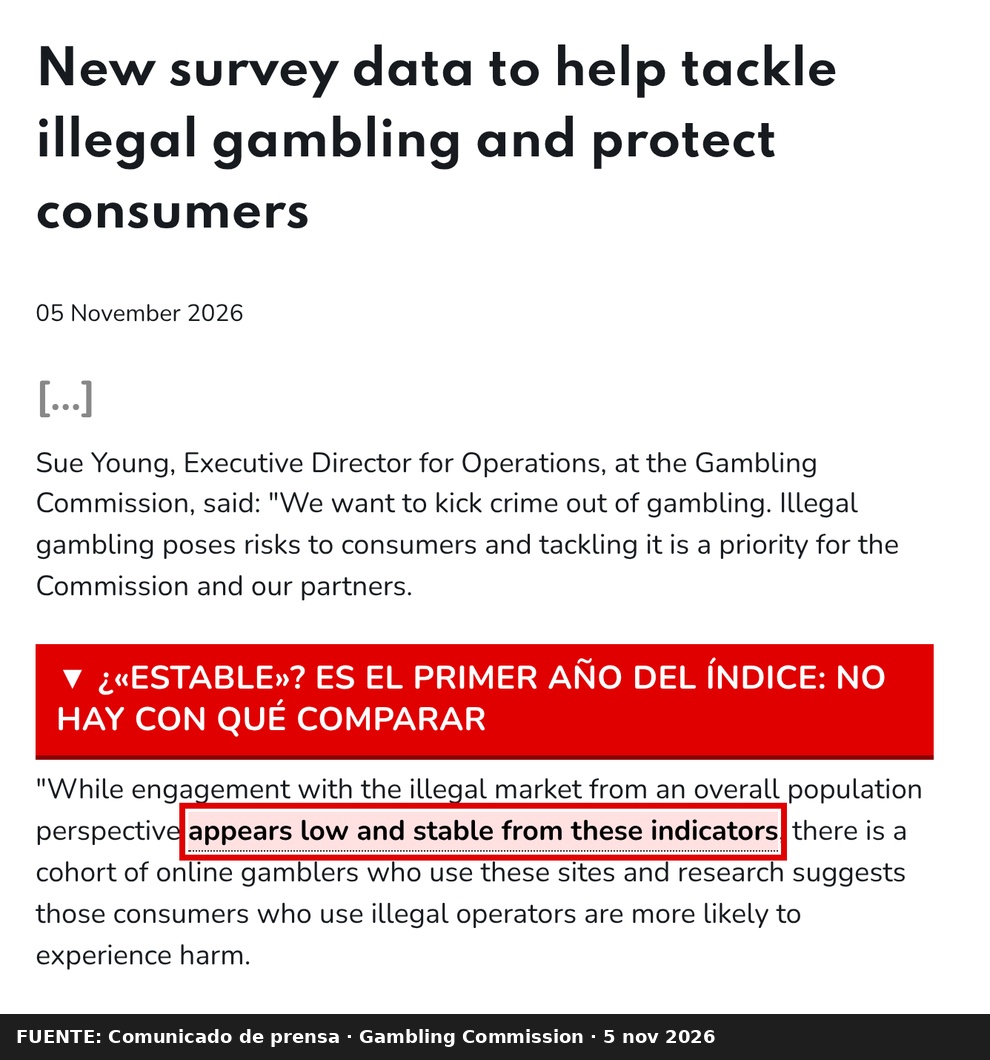
First question: stable with respect to what? The index that supports this diagnosis is now released. It uses data from the Gambling Survey for Great Britain, the country's largest official gambling survey, collected between April 2025 and April 2026, and is the first full year of questions that were first tested in 2025. There is no previous year to compare with. The regulator itself acknowledges this on the report page: only with future waves of data will it be able to "track trends over time". The word "stable" does not appear on any page of the report. It is only in the statement.
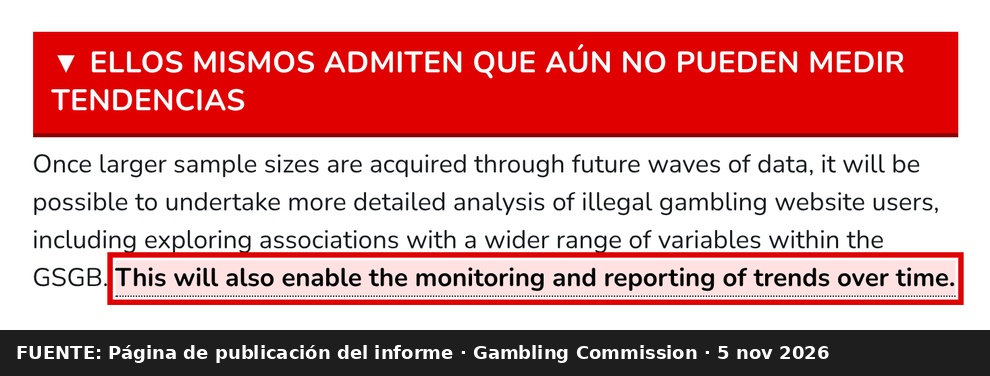
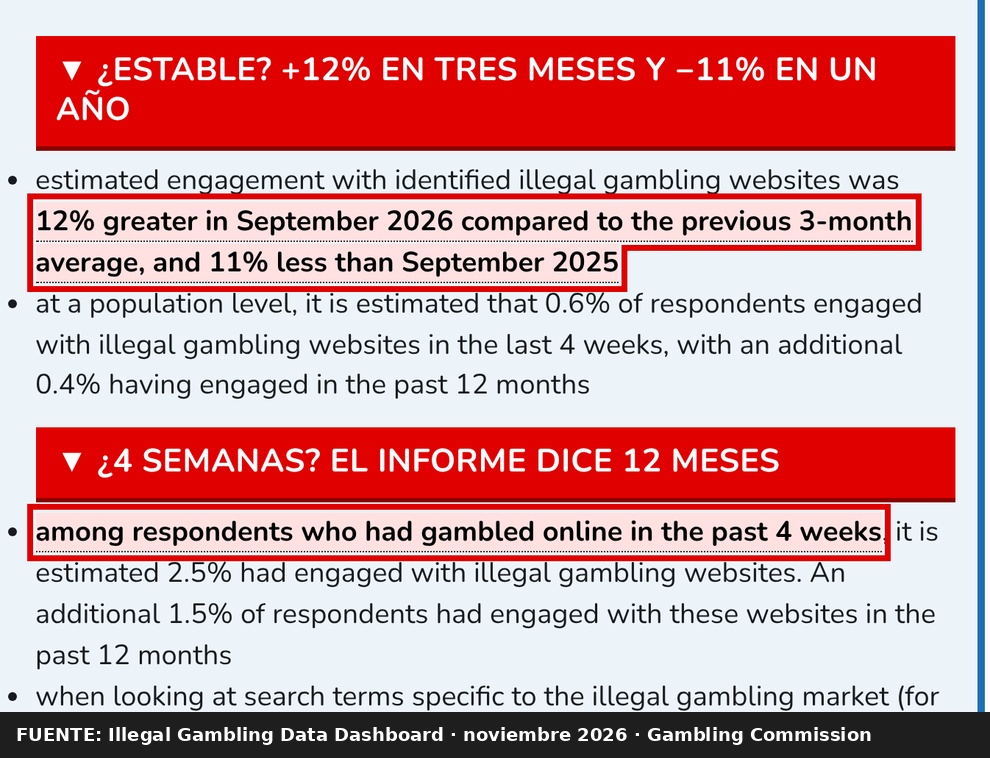
The only evolution that the regulator publishes on the illegal market is in its data panel and it is a different measurement: the estimated time spent on identified illegal websites. According to this measurement, activity in September 2026 was 12% higher than the average of the previous three months and 11% lower than that of a year earlier. Let each reader judge whether that is stability.
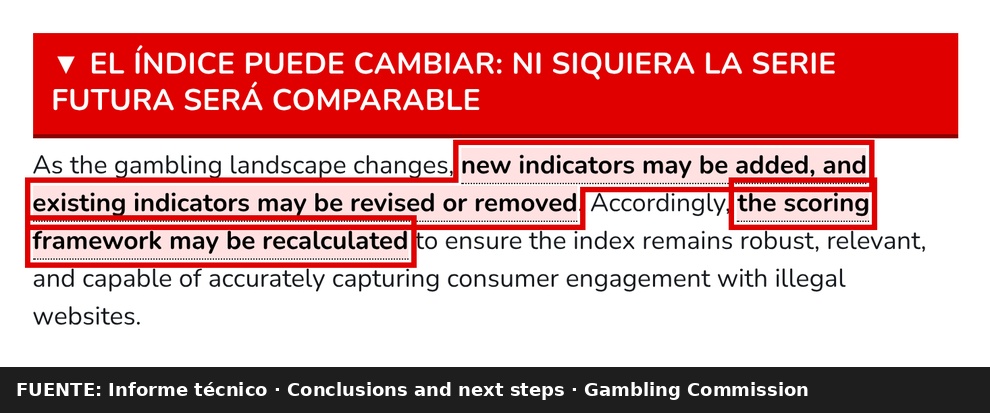
And there is more. The technical report warns that the index may change: indicators may be added, revised or removed, and the score may be recalculated . So it is not even guaranteed that next year there will be a series comparable to this year's.
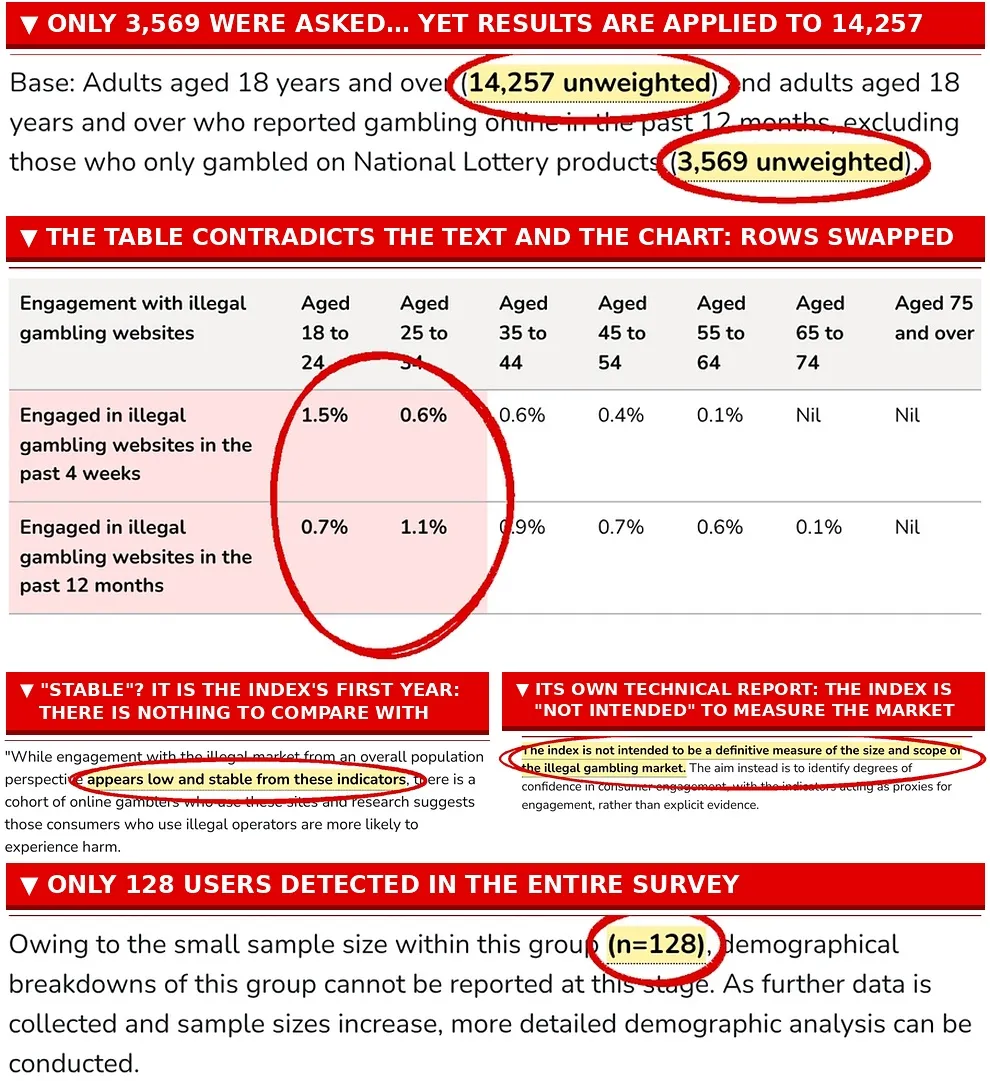
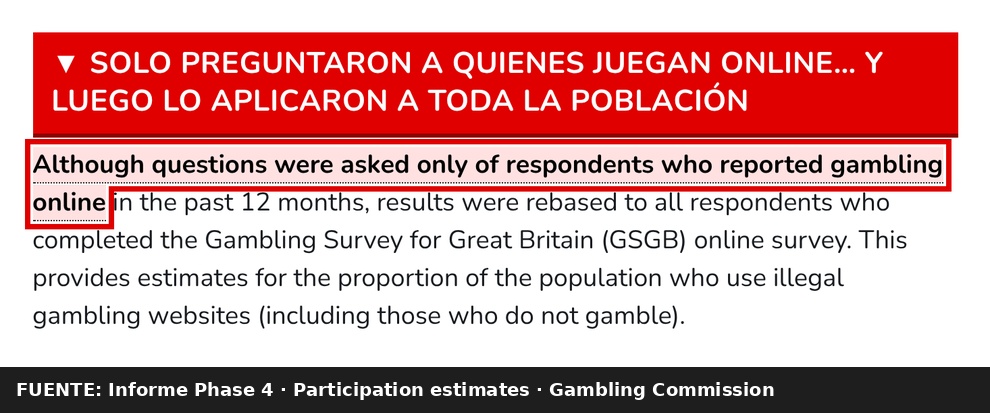
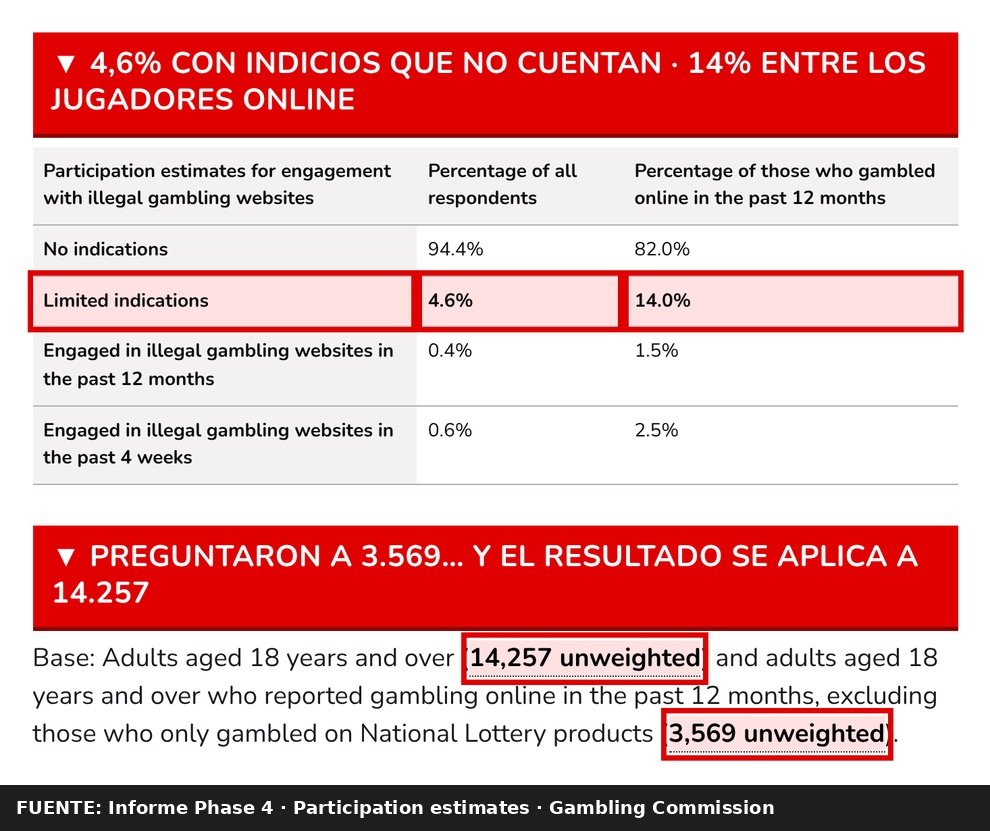
Let's go with the figures. The regulator concludes that 0.6% of the population used an illegal website in the last four weeks and another 0.4% in the last twelve months: the famous 1%. But the entire population was not asked. The questions about illegal gambling were only asked to 3,569 people: those who had gambled online in the last year, not counting those who only play the National Lottery. The result was then applied to the 14,257 participants who responded online. Those who were not asked directly count as "no indications" in that reassuring 94.4%. And those who answered the survey on paper were left out.
Nor does the statement talk about the doubtful. 4.6% of the population shows what the report calls "limited indications": some sign of having used illegal websites, but not enough to tell about it. Among those who gamble online, this group rises to 14.0%, more than three times the 4% of confirmed use.
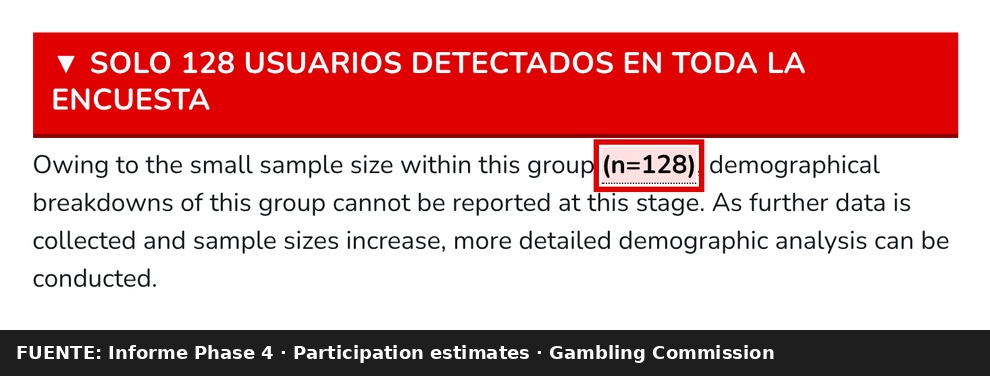
And how many users of illegal websites has the index actually detected? 128 in the entire sample. They are so few that the regulator itself admits that it cannot break them down by profile.
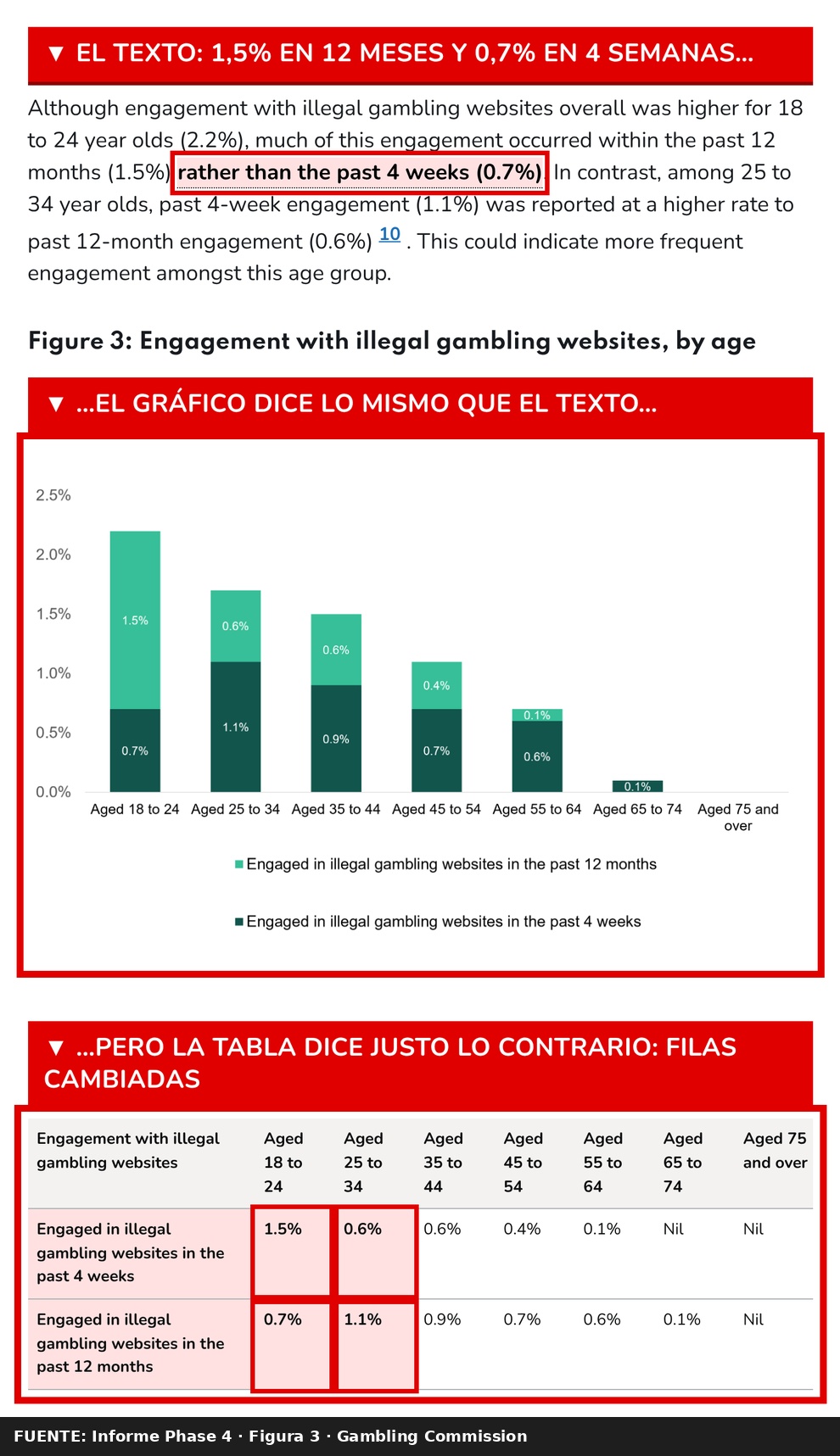
We come to the table. The text of the report says that young people aged 18 to 24 used illegal websites mainly throughout the year (1.5%) and less in the last four weeks (0.7%). The graph in Figure 3 says the same thing. The table that accompanies that graph says just the opposite: it has changed rows, and not only in that age group, but in all of them. The text and the graph say one thing and the table another, in the same document. And the reading by age is precisely what the statement highlights.
The reference group does not agree either. The report calculates 4% on those who gambled online in the last twelve months. The data panel calculates it on those who did so in the last four weeks.
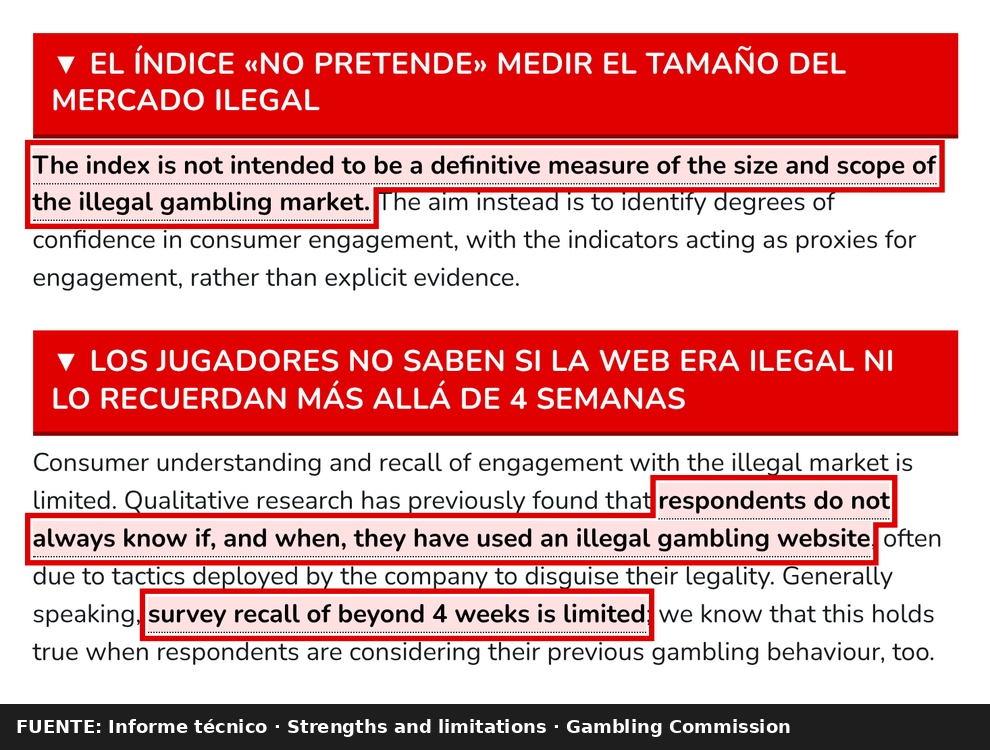
And the most striking is in the technical report, prepared together with the consulting firm Yonder. The index "is not intended to be a definitive measure of the size and scope of the illegal gambling market." Its indicators are approximations, "not explicit evidence." Players "don't always know if they've used an illegal website," and their recollection of what they did more than four weeks ago "is limited." Precisely that period is the 0.4%, almost half of the famous 1%.
None of this proves that the 1% is false. What it does show is that the British regulator has presented as low and stable a figure that its own documents treat with much more caution. There is one question that the Gambling Commission should answer: how can one talk about stability with the first year of an index that its own author says does not measure the market?
From Spain, the issue has its own interest. Illegal gambling is one of the priorities of the Directorate General for the Regulation of Gambling, which this week shared in Rome, with the regulators of Cyprus, Greece and the Czech Republic, its strategy against unlicensed operators. The British case leaves a lesson: when talking about illegal gambling, what is not known matters as much as the data that is announced.
SOURCE: Gambling Commission press release of November 5, 2026. Illegal gambling – Phase 4: Initial findings from new data on consumer engagement with illegal gambling websites, Phase 4: Illegal Gambling Index – Technical Report , and Illegal Gambling Data Dashboard – November 2026 report, all published by the Gambling Commission on November 5, 2026. Sue Young's quotes are from the press release.