An advisor to the Court of the European Union endorses that Italy bans all gambling advertising, but not online advertising when it targets a specific user
Advocate General Maciej Szpunar supports the Italian veto but points out that Italy did not inform Brussels and that this ruling could exempt operators from sanctioning part of the online advertising sector.


Italy has banned any type of gambling advertising since 2018, in any medium, including the internet and social networks. Now the Court of Justice of the European Union must decide whether that ban is compatible with European law. Advocate General Maciej Szpunar, who advises the Court before it issues its ruling, has presented his conclusions: Italy can ban all gambling advertising, but it made a procedural error that limits where it can apply that ban.
The case stems from a fine of 50,000 euros that the Italian communications regulator imposed on LeoVegas in 2019 for advertising its games on a Sky television channel. LeoVegas, based in Malta and licensed in Italy, appealed to the Italian Council of State, which asked the European Court to clarify several doubts.
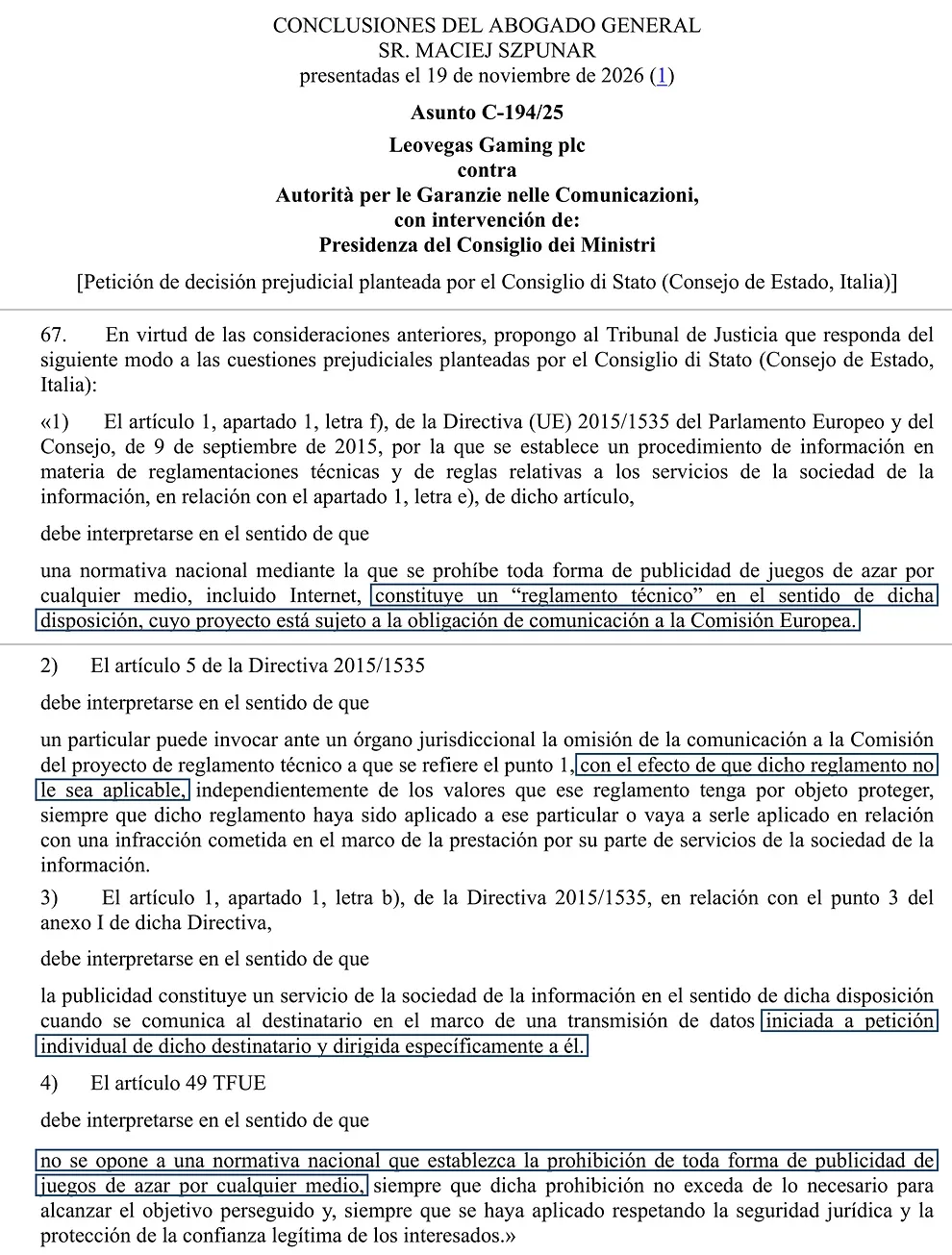
LeoVegas' first argument is that Italy did not notify the European Commission of the ban before approving it. That communication is mandatory when a regulation affects internet services. Szpunar agrees: since Italian law explicitly mentions internet and social networks, Italy should have notified Brussels. When a country does not do so, the regulation cannot be applied to companies regarding the internet, even if it protects health or consumers.
That is the nuance. For the Advocate General, that non-application only protects the operator in advertising that reaches the user individually, that is, that which appears because that person has requested it or is specifically directed at them. Advertising broadcast to everyone at once, such as an ad on conventional television, remains subject to the ban. The Italian Council of State will have to decide in which of the two cases the LeoVegas ad fits.
LeoVegas's second argument is that banning all advertising violates the freedom of establishment of European companies. At this point, Szpunar supports Italy. He acknowledges that preventing advertising limits operators. However, he reminds that each country has ample room to regulate gambling according to its own values and considers that the measure serves its objective: to combat addiction.
The Advocate General also rejects that it was enough to allow only advertising of legal gambling. In his view, Italy is not seeking to curb illegal gambling, but to reduce incentives to gamble in general, including among licensed operators. He adds that a company cannot expect the law never to change, although it can discuss how the change was applied, for example whether it had time to adapt. That will also have to be assessed by the Italian court.
Spain is one of the six governments that have submitted observations in the case, along with Belgium, Greece, Italy, Malta, and Portugal, as well as the European Commission. The Advocate General's conclusions are not binding on the Court, which will deliver judgment later.
Infoplay has already reported on other European cases regarding online gambling advertising. Among them, the conclusions that Google can benefit from the liability waiver regime in a case involving online gaming advertising on YouTube, and the ruling that opens the door for platforms to be held liable for online gaming advertising from their creators bound by commercial agreements.