Ireland defines eight categories of games that its licensees may offer, with the obligation to report the probability of winning
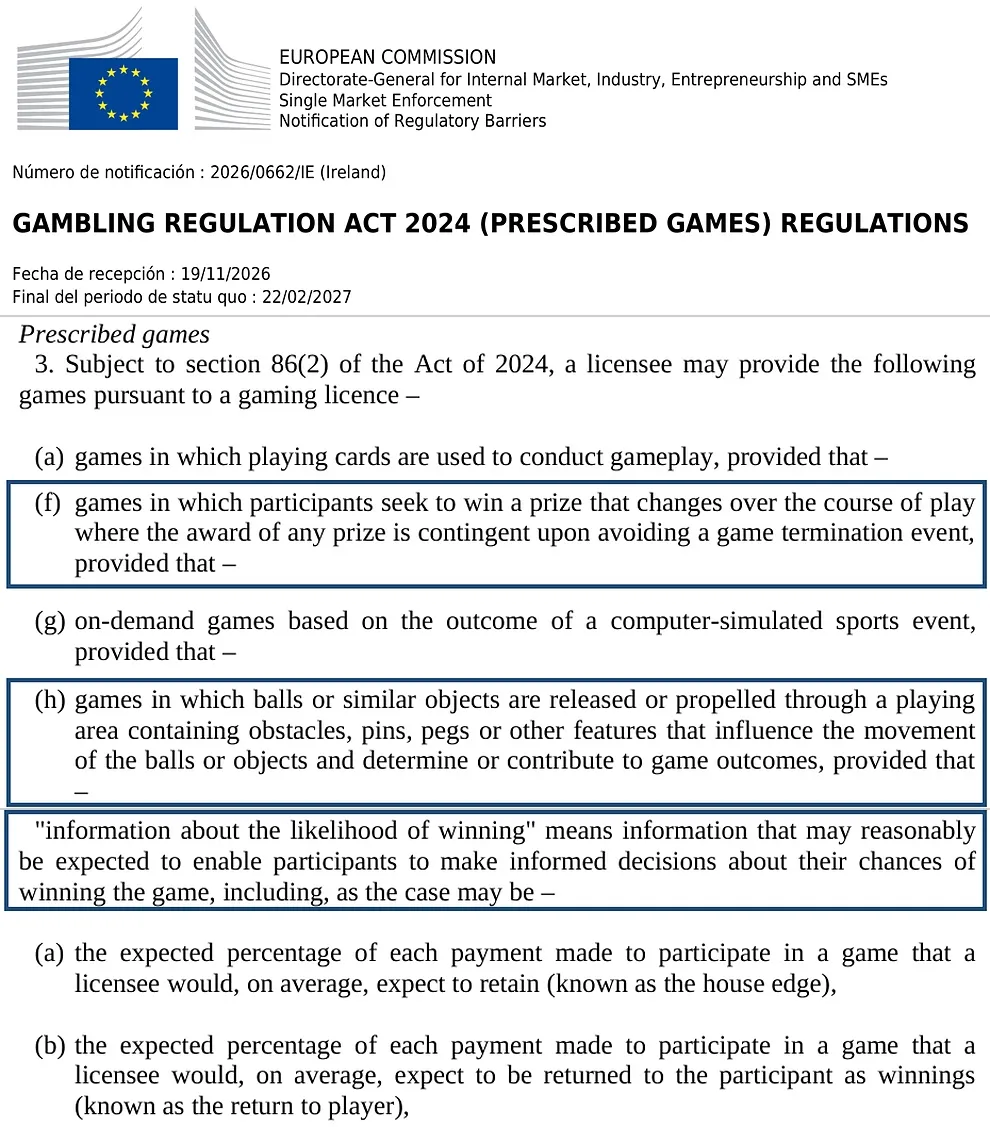


Ireland has notified the European Commission, through the TRIS system, of the draft Gambling Regulation Act 2024 (Prescribed Games) Regulations, the regulation that sets which games licensed operators may offer in the country. The notification, numbered 2026/0662/IE, was received on November 19, 2026, and the standstill period ends on February 22, 2027. Until that date, the Commission and the other Member States may submit observations.
The text comes from the Gambling Regulatory Authority of Ireland, the new Irish gaming regulator, and is channeled by the National Standards Authority of Ireland. It develops Article 86 of the Gambling Regulation Act 2024, which requires listing the authorized games. Each license will then specify which of these games its holder can offer.
The eight categories are card games; wheel games, including roulette; dice games; reel and symbol games; instant prize games, such as scratch cards or push button games; escalating prize games that end with a closing event; on-demand games based on computer-simulated sporting events, and ball drop games with pins or obstacles. The last two groups and the growing prize group, the format the sector knows as multiplier games, thus receive a specific fit in the Irish regulated market.
Each category has its own conditions. In card games, for example, the rules and information about the deck must be provided before playing, and the shuffle must be random and unalterable. In increasing prize games, the operator must explain how the multiplier scales, the bonus mechanisms, and the manual and automatic payout triggers. In ball drop games, they must indicate where the prizes are and show the course and the fall.
All categories share a requirement: to show the player "information about the probability of winning." The text defines it as the house edge, the return to the player, the odds, or the probabilities of winning events. In skill games, it must also explain how the game works and how it determines who wins.
In the justification sent to Brussels, the regulator explains that the list was drawn up based on games already offered in Ireland and the EU, after extensive sector research, with the aim of making it "light and technologically neutral." The prior public consultation received 123 responses from operators, suppliers, consultants, associations, and individuals. Participants generally supported the model but requested clarity, flexibility, and the ability to adapt to new products. They also warned that overly rigid technological definitions could lead to categories that are both restrictive and ambiguous.
The regulator recalls that in Ireland, gambling has historically been licensed in a fragmented way and that online gambling was excluded from the licensing system before the 2024 law. It also cites studies by the economic and social research institute ESRI from 2023 and 2025, which found higher levels of problem gambling than previous estimates indicated. Regarding the internal market, it considers that the impact will be minimal because the list includes games already offered throughout the EU. The notification clarifies that it is not a tax measure, that it has not been processed urgently, and that it is not accompanied by an impact assessment.
This is the latest piece in a series of notifications with which Ireland is rolling out its new model. A few days ago, Infoplay reported that Ireland sets a 1% contribution to finance the prevention of problem gambling. In October, the country took its new regulation on online player information to Brussels. The keys to the change lie in the analysis Ireland reinvents its regulated market: the changes that redefine the sector and how it will affect operators, and earlier this year Ireland opened the term for online and in-person betting licenses.