EXCLUSIVE ANALYSIS
How they can transform prediction markets, betting, and change the rules of the game
Polymarket and Kalshi have opened a regulatory battle that has already reached Spain and Europe, while FIFA, ADI PredictStreet, Matchbook and Betdaq show how this new business it is beginning to mix with traditional bets between users. INFOPLAY reviews the state of the art.


Yes. INFOPLAY has been following this issue for months and we have quite a bit of our own material, so in this piece it makes much more sense to link our news and build the context from there. I would leave it like this:
Polymarket and Kalshi have opened a regulatory battle that has already reached Spain and Europe, while FIFA, ADI PredictStreet, Matchbook and Betdaq show how this new business is beginning to mix with traditional bets between users. INFOPLAY reviews the state of the art.
Prediction markets have ceased to be a curiosity linked to elections or cryptocurrencies to become one of the great regulatory issues of the international gaming industry.
INFOPLAY has been following its evolution for months: from the growth of Polymarket and Kalshi to its entry into sport, the positioning of European regulators, the performance of the DGOJ in Spain and, more recently, the arrival of traditional game providers to this new model.
The question behind the whole battle is apparently simple: are they financial products or are they bets?
And the answer changes depending on the jurisdiction.
Polymarket and Kalshi are currently the two names that best represent the phenomenon.
Both allow you to take positions on future events: elections, economy, politics, sport or any other event whose outcome is still uncertain.
The operation is easy to understand. The platform poses a question and the user can position themselves for yes or no. If their prediction comes true, they make a profit; if not, they lose the money spent.
The big difference is in how this product is presented legally.
Kalshi defends in the United States that his contracts are products traded on a financial market regulated by the Commodity Futures Trading Commission (CFTC). Some American states, however, consider that when these contracts refer to who will win a game or a sports competition, we are dealing with a bet.
The dispute has escalated to the point that the NFL has asked the U.S. Supreme Court to rule on who should regulate these products.
INFOPLAY has also addressed the issue from the Spanish perspective: CNMV or DGOJ? Some contracts on future events can be close to financial products, while others have practically identical characteristics to a bet.
In Spain, the debate has had a much more forceful response.
On May 26, the General Directorate for the Regulation of Gambling opened disciplinary proceedings against Polymarket and Kalshi and ordered the blocking of their websites as a precautionary measure for allegedly operating without the necessary administrative authorization.
For the DGOJ, when users risk money on uncertain future events, we are dealing with a gambling activity subject to Spanish legislation.
The decision was later backed by Jdigital, which considered the blocking a necessary measure to protect the player and ensure that companies competing in Spain do so under the same rules.
Spain is not alone.
European regulators have been analysing the growth of these markets and their fit within the different national legislations for months.
In May, the DGOJ participated in Rome together with regulators from Germany, Austria, France, Italy, Portugal and the United Kingdom in a meeting in which predictive markets occupied a central part of the debate.
The World Lottery Association has gone even further and has defended that platforms that offer these products without a local gambling license operate illegally in those jurisdictions where their activity falls within the scope of gambling.
The phenomenon took a particularly significant leap when FIFA first added an official prediction markets partner.
In April, INFOPLAY reported the multi-year agreement with ADI PredictStreet, linked to Predict Street Ltd, a company licensed in Gibraltar.
The alliance placed these products directly around the 2026 FIFA World Cup, with markets related to matches, statistics, players and other events in the competition.
The move also had another novel component: Gibraltar had granted its first licence to an operator of regulated prediction markets.
Now ADI PredictStreet is back in the spotlight after an investigation by The Wall Street Journal has questioned a significant part of the volume recorded on its platform.
According to the analysis published by the US newspaper, of some 167 million dollars of operations, around 108 million would present patterns of circular operations between related accounts.
Simply put, the same money could have been repeatedly moving from one account to another, making the total volume seem much higher.
The data opens a new discussion that until now had been in the background: not only who regulates these markets, but also how their true activity is measured and what is behind the huge volume figures advertised by some platforms.
While all this is happening, the traditional market does not stand still either.
Matchbook has just bought Betdaq, one of the historic betting exchange platforms.
A betting exchange works differently than a traditional bookmaker: players bet against each other, and the platform charges a fee for putting them in touch.
That starts to look all too familiar when compared to prediction markets.
The connection becomes even more important because Matchbook is also technologically involved in the market development of ADI PredictStreet.
It does not mean that the purchase of Betdaq has any relation to the investigation into PredictStreet. They are different matters.
What's interesting is the direction the business is taking: a historic peer-to-peer betting company buys another exchange while, in parallel, using its expertise and technology to enter the new universe of prediction markets.
The boundary is further blurred with the entry of traditional suppliers in the sector.
This week INFOPLAY has told how the Malta Gaming Authority extended the B2B license of HGMT Limited, a Hacksaw company, incorporating Type 3 services that allow the deployment of a peer-to-peer platform of prediction markets for operators.
And it is not the only provider. In May, Slotegrator introduced Predictor, a solution aimed precisely at integrating prediction markets within casino and sports betting platforms.
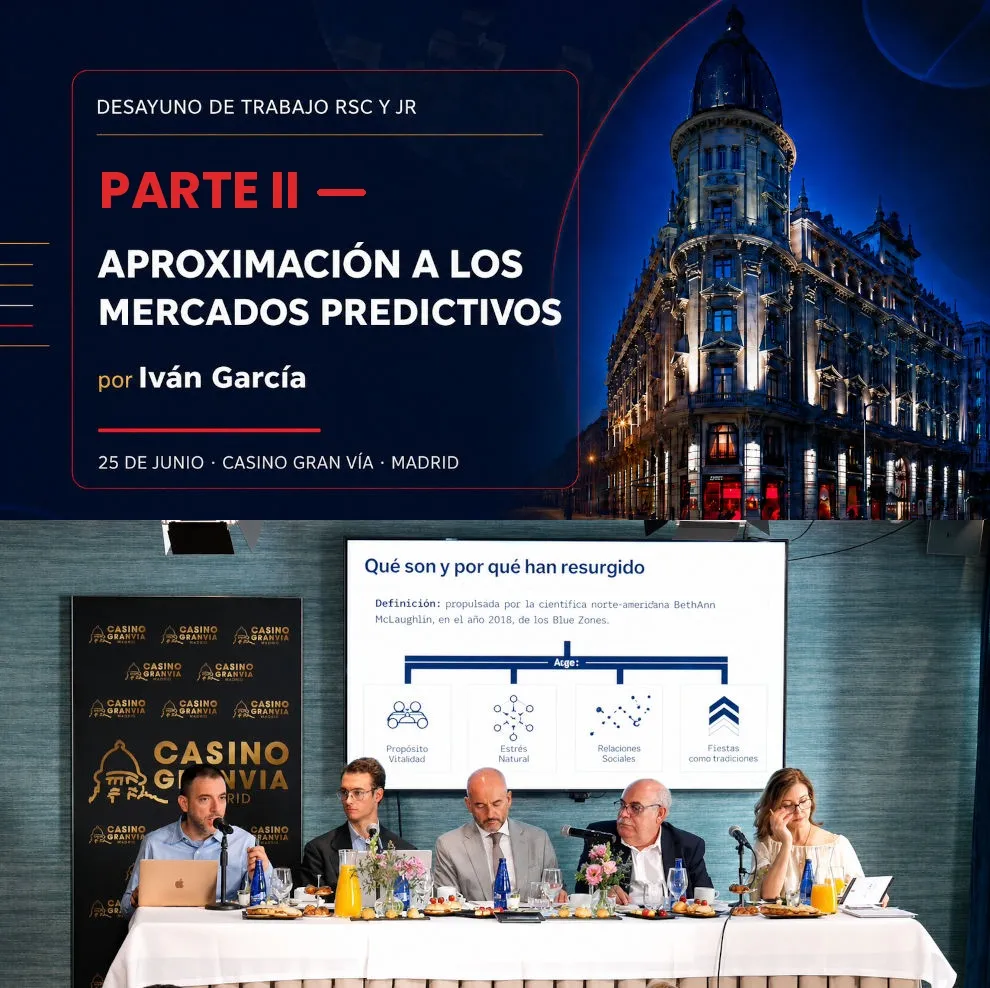
The dimension of this phenomenon led INFOPLAY to dedicate a specific space to it within the CSR and Responsible Gaming Working Breakfast held at Casino Gran Vía COMAR, where for the first time the irruption of predictive markets and their impact on the regulatory balance between land-based and online gambling was addressed in a Spanish forum.
At that meeting, Iván García explained precisely that the phenomenon should not be analysed only by asking whether Polymarket or Kalshi will ever be able to operate in Spain. The real question is what changes they are already introducing in the product, in the user and in the regulated industry itself.
And that forecast is beginning to be fulfilled.
The October 2026 map is much more complex.
Polymarket and Kalshi represent the massive growth of the new model.
The CFTC and the U.S. states are arguing over who has the capacity to regulate it.
Spain and much of Europe consider that many of these products fall directly into the field of gambling.
ADI, PredictStreet and FIFA have brought the model to the world's largest sports showcase.
Matchbook and Betdaq show how traditional bets between users are approaching this new ecosystem.
And providers like Hacksaw and Slotegrator demonstrate that prediction markets are starting to enter the regulated industry's tech offering as well.
That is why the question has changed.
It is no longer just a question of whether prediction markets are bets or financial products.
The question now is to what extent they will end up transforming traditional betting, who will manage to regulate it and what rules they will have to comply with when the boundary between gambling, trading and the market becomes increasingly difficult to distinguish.