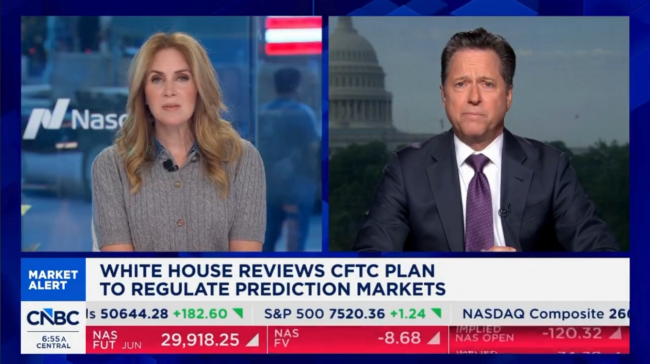
AGA President Bill Miller tells CNBC the U.S. gaming industry remains resilient as digital growth accelerates
The President and CEO of the American Gaming Association (AGA), Bill Miller, analyzed the current state of the sector during his appearance on CNBC's 'Squawk Box.' Miller underscored the industry's remarkable resilience, the success of the digital transition, and the firm stance of 41 attorneys general against federal overreach by the CFTC regarding prediction markets like Polymarket and Kalshi.
INFOPLAY |
The gaming and entertainment industry in the United States continues to demonstrate exceptional financial strength, defying global economic uncertainties. In a recent interview on CNBC's prestigious financial program 'Squawk Box,' Bill Miller, head of the American Gaming Association (AGA), offered a detailed overview of the sector's excellent momentum, highlighting both the performance of land-based venues and the unstoppable expansion of sports betting and online gaming.
During his interview, Miller emphasized that, far from experiencing a slowdown, the gaming market has consolidated the record levels achieved in recent years. This dynamism is largely due to the ability of operators to adapt to new consumer demands, as patrons continue to prioritize land-based leisure experiences in iconic destinations like Las Vegas while naturally integrating digital alternatives into their daily lives.
A fundamental pillar of this sustained growth is the rise of legalized sports betting. Since the repeal of the federal ban in 2018, dozens of states have developed safe and competitive regulatory frameworks. Miller noted that opening these markets not only generates significant tax revenues for public administrations but also fulfills the primary objective of shifting users away from the illegal black market into a fully supervised, transparent, and secure environment.
A key point of discussion during the interview was the controversial rise of election prediction markets. Miller strongly defended the regulatory sovereignty of states and tribes against oversight attempts by federal agencies like the Commodity Futures Trading Commission (CFTC), which has been reviewing platforms such as Polymarket and Kalshi. Miller revealed that 41 attorneys general from across the country, representing every political stripe, recently weighed in unanimously to state that while the CFTC plays an important role in the nation's economy, they are not the regulator of national sportsbooks or betting platforms.
Miller clarified that this stance is not about protecting the exclusive interests of the AGA or the gaming industry itself, but rather safeguarding the revenue of states and tribal communities. According to the executive, the proliferation of these alternative prediction platforms causes states and tribes to literally lose $1 billion in revenue. In a well-defined legal framework, these funds would otherwise go directly to fund important community projects and pay taxes to these states.
When asked by the CNBC anchors about the risks associated with rapid digital expansion, the AGA president placed social responsibility at the center of the association's corporate strategy. Miller stated that the industry's economic growth is meaningless unless accompanied by a rigorous and proactive commitment to responsible gaming. In this regard, the multimillion-dollar investments that sector companies continuously make in awareness campaigns and technological self-exclusion tools ensure that the activity remains strictly a healthy option for leisure and entertainment.
Finally, Miller expressed optimism regarding the medium- and long-term future. Despite external factors such as inflation or changes in interest rates, consumer spending on recreational activities remains strong. The solid balance sheets of sector companies and constant technological innovation suggest that the gaming industry will continue to be one of the most stable economic drivers and job creators in the business landscape.
Esta página web utiliza cookies propias y de terceros, estadísticas y de marketing, con la finalidad de mejorar nuestros servicios y mostrarle información relacionada con sus preferencias, a través del análisis de sus hábitos de navegación. Del mismo modo, este sitio alberga web beacons, que tienen una finalidad similar a la de las cookies. Tanto las cookies como los beacons no se descargarán sin que lo haya aceptado previamente pulsando el botón de aceptación.