THE GAME CREATOR
Paul Gauselmann's obituary
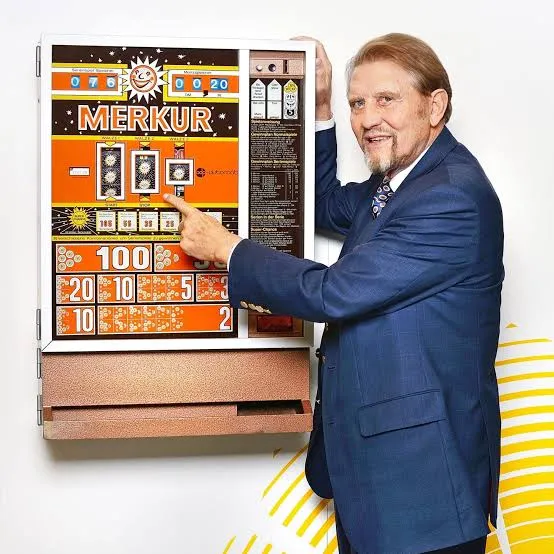


Paul Gauselmann, founder and, for decades, chairman of the Board of Management of the Merkur Group, has died today, shortly before his 92nd birthday. Born in Westphalia, after the Second World War, he turned a one-man business into an international group with more than 15,000 employees and a total turnover of around 2.1 billion euros. For 67 years he shaped the company and for decades also acted as a supporter for the entire German gaming and arcade industry. In 2003 he was awarded the Cross of the Martyr of the Federal Republic of Germany, First Class, and in 2004 he was appointed Honorary City of the cities of Espelkamp and Lübbecke. He is survived by his wife, Karin, four children, nine grandchildren and seven great-grandchildren.
Paul Gauselmann, founder and charismatic leader for decades of the Merkur Group, passed away on August 21 at the age of 91. This is an obituary for one of the last patriarchs of the postwar era: a courageous fighter with grand visions, a proud father, (great)grandfather and husband.
The news of his death has caused a great commotion at the Group's headquarters on Merkur-Allee in Espelkamp and in all the production halls on Paul-Gauselmann-Straße in Lübbecke. None of the employees is resigned to accepting that PG – as he was called with respect and affection – is not going to park at any time, as he did for decades, at the wheel of his sedan. His presence is still clearly felt everywhere. Even after leaving the Group's top management in 2024, he continued to attend the office for many months on Tuesdays and Thursdays to oversee day-to-day operations.
For 67 years he forged the destiny of the corporate group, transforming what was once a one-man business into an internationally successful Group with more than 15,000 employees and a total turnover of around 2.1 billion euros. He was a much-loved company director, an inspirational leader from start to finish. Even as a Group Director, PG always liked to take time to chat briefly with his employees, regardless of their position in the company. A word of thanks here, a sincere interest there; Paul Gauselmann always treated everyone with respect. His own experience as an employee taught him the importance of appreciation and one-on-one communication. He remained true to this guiding principle throughout his life.
Paul Gauselmann was born in 1934 in Borghorst, near Münster (Westphalia, Germany). At the age of only two he lost his mother and was subsequently raised by relatives in Münster, separated from his father and four siblings. He was five years old when World War II broke out. As a child, Paul experienced devastating air raids, constant fear, and great hardship. These experiences taught him from an early age to improvise and to assert himself. During the long nights when he couldn't sleep because of air raid sirens, he also learned to value play: "We used games just to pass the time and distract ourselves from our fears," he once said.
In 1950 he graduated at the top of his class and began apprenticeship training as a telecommunications inspector, after which he was quickly promoted to head of his own inspection department. In 1956 he began working for a vending machine manufacturer in Coesfeld, which was also the general importer of American Wurlitzer jukeboxes. During this time, Paul Gauselmann developed the first remote sorting unit for German jukeboxes, which he introduced to Harting, the Espelkamp-based jukebox manufacturer. Shortly afterwards he was hired as a technician and, just four years later, at the age of 26, he was promoted to head of the machine development department. This was the beginning of Paul Gauselmann's story in Espelkamp, his adopted home, together with his young family.
Paul Gauselmann's drive and inexhaustible creativity were fueled by his unwavering desire for independence. In 1957 he took up a part-time job as an independent jukebox operator, which in 1964 led him to fully establish himself as a self-employed gaming machine operator in the hospitality industry. At that time, commercial gaming with machines was out of public view. He wanted to change that: in 1974, at the age of 40, he opened his first arcade in Delmenhorst, Lower Saxony, to the standards of a four-star hotel. Its first internally developed slot machine – the Merkur B – conquered the German market in 1977 and fuelled the Group's rapid growth. This was followed by countless in-house developments, hundreds of patents and a decisive move into the international market. Today, the trademark he devised — the smiling Merkur sun — is popular around the world as a symbol of gaming and entertainment. However, his rise to prominence was not due to mere luck: "Otherwise, I don't believe much in luck. I do believe, on the other hand, in coincidences in which you can take advantage of the opportunity or not," was always his credo. And that's exactly what he did: he worked hard, showed perseverance, and exhibited great willpower.
In addition to making his own company a success, Paul Gauselmann was also always focused on the well-being of the entire gaming and arcade machine industry. As early as the 1960s it was instrumental in shaping the sector's policy within trade associations, and it did not shy away from conflict in the process. He sought direct contact to speak directly to other members of the industry rather than talking about them, a strategy that earned him the respect of all. For more than 38 years he shaped the industry, 28 of which as chairman of the Board of the Association of the German Vending and Recreational Machine Industry (Verband der Deutschen Automatenindustrie e.V.), and played a decisive role in its transformation into a relevant economic sector. Both his colleagues and his competitors admit this without a hint of envy: "We wouldn't have come this far without Paul Gauselmann."
Of the Merkur Group's current workforce of more than 15,000 members, more than 2000 are located in Espelkamp and Lübbecke. This makes the company one of the most important employers in the Minden-Lübbecke economic region. To ensure the future of the Group for generations, the shares of all Gauselmann family companies were transferred in 2016 to the Gauselmann Family Foundation, which is the sole owner of the Merkur Group. Paul Gauselmann remained as chairman of the Foundation's Board until 2024. He then handed over the reins to his son, Michael Gauselmann, thus sending a clear signal that the Group would continue to be a family business.
"I have two Pauls," his wife, Karin Gauselmann, once said, because he was more than "just" a businessman: he was a father, grandfather, great-grandfather and husband. "My family is the most important pillar of my life, both personally and professionally," something he never tired of emphasizing. He met his wife Karin on a winter vacation in 1967. Soon after, the Berlin-born woman followed him to the quiet village of Espelkamp, became his closest confidant, and filled the void in the lives of his three sons — Peter, Michael, and Armin — left by the death of their biological mother. In 1969 their son Karsten was born. Until the end, Paul lived with Karin Gauselmann in her house in the Espelkamp countryside, surrounded by the nature he loved so much. Settled in a small town, Paul Gauselmann saw the whole world through countless cruise ships, and the whole world saw him.
Wherever he appeared in his trademark three-piece suit, he attracted friends and admirers, but also critics and envious people. Paul Gauselmann himself was not a jealous or greedy man. He always gave something back to society and supported numerous projects in the field of social welfare, culture, sports and health. He also created the charity Paul Gauselmann Foundation, which later, together with his wife Karin, became the Paul and Karin Gauselmann Foundation, to which he transferred all his personal assets and that of his wife. Karin Gauselmann will continue her work even after his death, thus ensuring that part of Paul Gauselmann's great character will last forever. In recognition of his social commitment, he was named honorary citizen by the cities of Espelkamp and Lübbecke in 2004; in 2003, the then President of Germany awarded him the Cross of Merit of the Federal Republic of Germany, First Class.
With the acquisition in 2010 of the dilapidated Schloss Benkhausen Castle in Espelkamp, which is 500 years old and only a few kilometres from his home, he erected an enduring monument to his life's work. After extensive restoration work, a modern training center with hotel facilities was created, and an old barn on the estate houses the German Museum of Coin Vending Machines - Gauselmann Collection. It also showed a special commitment to supporting medical and emergency care projects in the Minden-Lübbecke district, as well as several amateur and professional sports clubs. He had a particular passion for tennis: at his local tennis club, Espelkamp-Mittwald e.V., he participated as sponsor and honorary president, being himself an active member of the club's team. Whether on the tennis court, in the gaming industry or on the punished streets of post-war Münster, Paul Gauselmann fought many battles throughout his intense life and remained undefeated until the end.
Even in his later years, the father of four — and whose family now includes seven great-grandchildren — remained tireless in his social commitment. Not only did it finance the construction of two early childhood education centers in Espelkamp with an investment of about 6 million euros; When the city recently found itself in financial difficulties through no fault of its own, he stepped up once again with a donation of €8.7 million. To ensure that the neighbouring town of Lübbecke, where the Merkur Group's production plant is located, was not left behind, it provided an additional €5 million. In a matter of just a few months, Paul Gauselmann contributed around 20 million euros to the public good. As an old-fashioned businessman, he had always lived austerely; Material wealth had never been the main driver of their actions. He enjoyed helping people and making the region a better place to live, whether it was through new children's facilities, fire trucks, or better medical care.
For all those who knew Paul Gauselmann, his loss is still difficult to assimilate. However, as he would have liked, our gaze remains fixed on the Merkur sun. "Where my sun shines and where my stars are, there you can see the glow of hope and the light of freedom in the distance," Caterina Valente once sang, a song that accompanied him from the beginning of his career as a young jukebox operator to the end.
The time has come to say goodbye to Paul Gauselmann. The Merkur Group, together with all its employees, pays tribute to an extraordinary person, with humility and deep gratitude.