PAF funds canine rescue units ready to act when police need them
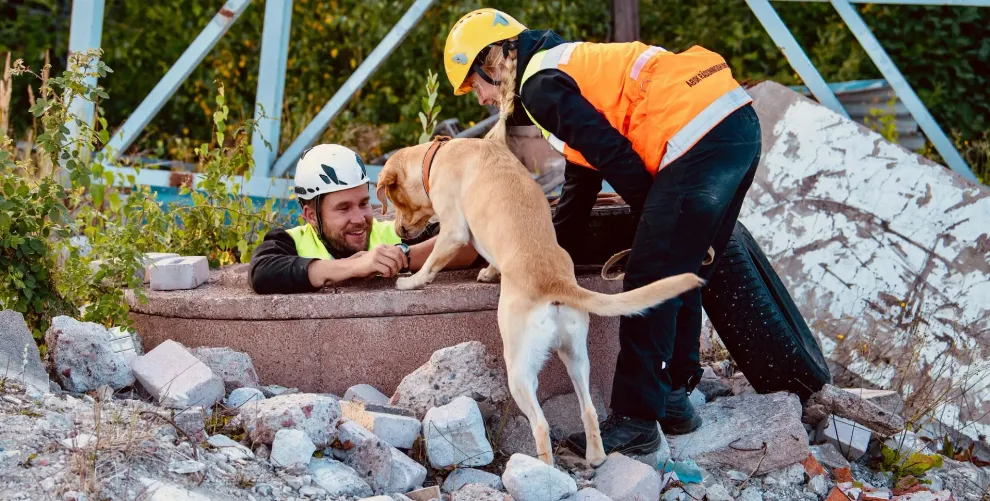
When a person goes missing, every minute counts. With the support of the operator Paf, ÅBSK's rescue dogs can train and equip the guide and dog teams that are at the disposal of the police in the Åland Islands (Finland).


With the support of gambling operator Paf – based in the Finnish autonomous archipelago of Åland – ÅBSK, a local entity dedicated to rescue dogs, can train and equip guide and dog teams that remain ready for when the police call them back.
Walking up the fenced hill of Färjsundet in Åland, it only takes a little imagination to believe that a part of the archipelago is recovering from a nuclear war. Exposed concrete blocks, stretches of tiled floors, concrete pipes, sheet metal and debris of all kinds are scattered in all directions. But the site – known simply as "the ruin" – is not the result of an explosion: it has been deliberately built for ÅBSK's rescue dogs to practice searching for missing people in collapsed structures, an environment with an extreme number of hiding places and where even a dog finds it really difficult to move.
Linda Larsson is group leader of the ÅBSK rescue dogs and one of the six people present at this training session in mid-August.
"We train in several different places, but the ruin is especially good because there are so many hiding places and a lot of difficult terrain for the dogs. It's a good exercise for the dogs to gain confidence," he explains.
How many dogs there are exactly within ÅBSK's rescue operations is something Linda cannot specify by heart: there are many teams in different stages of formation. She has three dogs herself.
"My dogs and I train every day. Why? Because this is my thing, my great passion outside of work. Some people go to the gym, there are those who fish, and I do this. It's something I love to spend time on, and the times we are called for an intervention are a big part of the motivation. I know that this dog can follow a trail for twelve hours, and if you have to find someone quickly, she is the right dog: it's an instant, and she's already out," she says.
A resource for law enforcement
ÅBSK's dog handlers work on a completely voluntary basis and cover most of the costs of their dogs themselves. Paf's funding, on the other hand, makes it possible to cover what the group needs collectively: GPS equipment, among other things, and the cost of bringing instructors and judges to Åland. The latter is essential so that the teams can be trained, examined and approved for real interventions. Last year, ÅBSK's rescue dogs were required by the police on eight separate occasions.
"We operate under the Voluntary Rescue Service (FRT), and we are responsible for the FRT who are called by the police when they need help. We have collaborated in boat evacuations, searches for missing persons, tracking lines and similar work," says Linda Larsson.
"Of course, the police also have their own dogs, but not all of them do people searching, a large area may require a lot of dogs, and the police may also run out of dogs if theirs are out, in training in Finland. So I think we are quite an important resource for them, especially because they have been involved in the homologation of the dogs and have seen them in action, which means that they also know what we can contribute," he adds.