On Monday, August 4, 2025, the Directorate-General for the Regulation of Gambling (DGOJ) published the 2024
Annual Report on Gambling Activity in Spain, an annual report that has gained notable media attention as it was presented with a distinctly political and interpretative tone, hinting at a clear orientation towards justifying future advertising restrictions.
For this reason, we will begin this detailed analysis by pointing out the wide media coverage and the importance attributed to the document. We will then focus on sector data, highlighting the figures of regulated online gambling, player profiles, and advertising expenditure—emphasizing what most mainstream media have chosen to ignore (the data from the public and reserved gambling sectors)—to conclude with the real backdrop that this biased reading of the document aims to underscore, providing elements overlooked by the press that may explain some of the results from 2024.
The Most Media-Covered Report
As usual, the 2024 Report breaks down key information from the year—both online and land-based—on aspects such as gambling volume, Gross Gaming Revenue (GGR), player numbers and profiles, types of games, marketing, etc. It was prepared in collaboration with the autonomous communities, significantly expanding the geographical scope and bringing together, for the first time, comprehensive data on all gambling activity in Spain, encompassing both state-level online gambling and regional land-based gambling.
The document has become the main official source for analyzing the reality of the gambling sector. However, this time the Ministry of Consumer Affairs has chosen to surround it with a strong political narrative, ignoring some data and directly linking other figures to the relaxation of advertising restrictions following the Supreme Court ruling in April 2024.
The publication of the 2024 Report has received widespread coverage in mainstream media, showing that the document aims not only to inform but also to legitimize future restrictions on online gambling advertising, especially regarding promotional bonuses and acquisition strategies. A quick look at national newspapers like
El País shows headlines emphasizing that “the number of players has increased by more than 20% with welcome bonuses,” also taking the opportunity to recall the legal context—the ban on bonuses since 2020 and the 2024 ruling that reinstated them—and exaggerate the impact of these offers, which are described as “easy money” for the “novice gambler.”
The media also reported on the political response. For example,
eldiario.es highlighted that Pablo Bustinduy’s department (Ministry of Consumer Affairs) seeks to “reinstate the ban” on bonuses through a legislative amendment. In the same outlet, it was emphasized that the aim is to protect players, especially young people, from aggressive commercial practices. It was also noted that, despite the advertising restrictions in force since 2021, operators found in 2024 “
a legal loophole” to “intensify their marketing until the law catches up.”
General Gambling Results in 2024
Using the sector’s most common metric—Gross Gaming Revenue (GGR)—it stands out that during 2024, gambling operators in Spain earned €8.108 billion in GGR. This figure is an indicator that measures the difference between the total amounts wagered and the prizes paid out. The total gambling volume (i.e., total amounts wagered) showed a 7.1% increase in 2024 compared to the previous year.
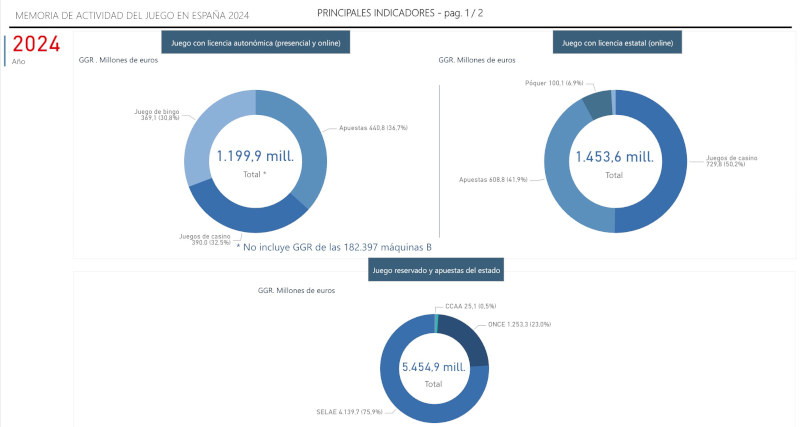
When considering the breakdown by major segments (state-licensed online gambling, regionally licensed land-based gambling, and state-reserved gambling), we see that state-level online gambling reached €1.454 billion in GGR in 2024, representing year-on-year growth of +17.6%. Regionally licensed private land-based games generated €1.199 billion in 2024 (+2.5% annually), while state lotteries and mutual betting contributed €5.454 billion (+9.2% annually). This last category includes the National Lottery, ONCE, and state-run mutual betting.
As the data show, all segments of the gambling market grew in 2024, with the standout being the increase in state-licensed online gambling (+17.6%), contributing to an overall sector-wide GGR increase of nearly 10% year-on-year, from €7.4 billion in 2023 to over €8.1 billion in 2024.
A Noteworthy Performance of Online Gambling
In the online segment with a state license and the Directorate-General for the Regulation of Gambling as the regulator (casino and slots, sports betting, poker, online bingo), operators obtained €1.454 billion in GGR in 2024. The 2024 Report details the distribution of this revenue by type of game and we also highlight its evolution compared to 2023:
- Online casino: €730.7 million GGR in 2024, representing approximately 50% of online GGR. It grew by +16.96% compared to 2023, driven mainly by slot machines.
- Online sports betting: €608.9 million GGR (~42% of the total online) in 2024, with the highest year-on-year growth (+23.8%). This leap was led by fixed-odds sports betting, especially in its live mode during events such as football matches.
- Online poker: €100.1 million GGR (~7% of the total) in 2024. Unlike other segments, it suffered a decline of 4.99% compared to 2023, confirming a drop in the popularity or spending on poker.
- Online bingo: €14.9 million GGR (~1% of total online) in 2024, with a slight year-on-year increase of 3.96%. This segment maintains a marginal share of the online market.
These figures indicate that sports betting and casino continued to be the engines of online growth in 2024. The document highlights that the largest absolute increase in revenue occurred in betting, with nearly +24% (especially in live betting), followed by casino with +17%, while poker declined slightly and bingo showed modest growth. It is worth noting that in 2023 the situation was also positive for casino and betting (which grew by +25% and +37%, respectively), but 2024 further consolidated the upward trend of online sports betting.
Active Players and Demographic Profile
A key figure is the notable increase in online player participation during 2024. The total number of active online players (with at least one bet placed during the year) nearly reached 2 million users (1,991,550), representing a +21.63% increase compared to 2023. In the previous year, the volume of players was slightly over 1.6 million, meaning that 2024 registered around 360,000 more active players than in 2023. Additionally, 459,266 new players joined online platforms throughout the year.
Regarding the demographic profile, the composition of online players remained imbalanced by gender and concentrated in young adults, similar to previous years. Official data show that 8 out of 10 online players are men (83.15% men vs. 16.85% women). By age group, the vast majority of players (85.7%) are between 18 and 45 years old, demonstrating that the young adult audience dominates online gambling.
The 2024 Report also provides information on the frequency of gambling through active accounts. In 2024, there was an average of 1,433,715 active accounts per month, which implies a +23.48% increase over the monthly average of 2023. This figure suggests that in a typical month of 2024 there were around 1.43 million unique users gambling, compared to 1.16 million in 2023. Similarly, the monthly average of new accounts (player registrations) increased by +34.73%, reaching around 151,898 new accounts per month in 2024.
Investment in Marketing and Advertising
The increase in new registrations reflects the effect of certain commercial strategies in 2024, such as welcome bonuses — a key aspect of operators' acquisition policies. Specifically in 2024, total marketing expenditure by state-licensed operators amounted to €526.3 million, representing a +30.36% increase over the previous year. This figure includes allocations to advertising, promotions, affiliation, and sponsorship. In fact, 2024 marks a record in commercial investment by the sector, following the partial relaxation of certain advertising restrictions in mid-2024 after the Supreme Court ruling.
The breakdown of marketing investment in 2024 was as follows: approximately €261 million (50%) was allocated to promotions — including bonuses and player offers; €203 million (39%) to traditional advertising (media ads, internet, etc.); €56 million (10%) to affiliates (referral programs); and around €5.4 million (1%) to sports or other sponsorships.
Promotions thus constituted the largest spending category. This increase contrasts with the trend in 2023, when marketing investment was €402.8 million (just +7.6% compared to 2022). Even under the strict regime of Royal Decree 958/2020 — which drastically limited gambling advertising since 2021 — promotional spending remained around €200 million in bonuses in 2023.
Public Gambling
There is no doubt: although public games usually receive less media attention, SELAE and ONCE represent the structural backbone of the gambling market in Spain. If in 2023 they already contributed more than €5.1 billion in GGR combined, backed by growing sales of scratch cards, lotteries and coupons year after year, 2024 confirms the growth of ONCE (sales +9.2% between January and August, with a strong performance from scratch cards and active lotteries) and SELAE, which maintains its solid presence with a stable retail network and notable investment in advertising and sponsorships.
If in 2024 we said that the GGR figures for online gambling amounted to €1,453.6 million, ONCE surpassed €1,253.3 million, confirming its clear commitment to scratch cards and online games, while SELAE continues relying on the traditional Christmas Lottery and La Primitiva, maintaining its territorial dominance at physical points of sale and growing in advertising and sponsorships.
Welcome Bonuses
One of the most prominent conclusions of the 2024 Report in its media coverage — and emphasized by the authorities — has been the link between the growth in players and the return of “welcome bonuses” from betting companies. These promotional bonuses (e.g., “double your first deposit”) serve to attract new customers by offering free bets or credits. These practices had been banned in Spain since 2020 under gambling advertising regulations (Royal Decree 958/2020), but in April 2024, the Supreme Court overturned the ban by striking down several articles of said decree. As a result, operators were once again able to offer acquisition bonuses from mid-2024.
According to the Ministry of Consumer Affairs, this reinstatement of bonuses had an immediate effect on participation: the number of online players increased by +21.63% in 2024, after having remained almost stable the previous year. In other words, more than 350,000 additional players joined during the year the bonuses returned. However, although Ministry sources directly attribute this “huge increase” to the appeal of welcome bonuses, what has been completely overlooked is that Spain experienced a memorable 2024 in sports — especially in men’s football.
The national team won the Euro Cup in Berlin after defeating England 2–1 with a decisive goal by Mikel Oyarzabal, and days later took Olympic gold in Paris after beating France 5–3 in the final. At the club level, Real Madrid lifted its 15th Champions League title, reinforcing Spanish football’s dominance in Europe. Individually, Rodri was awarded the Ballon d’Or, and Lamine Yamal won the Kopa Trophy for the best young player, rounding off a perfect year for “La Roja.”
Tennis also brought joy, with Carlos Alcaraz winning both Wimbledon and Roland Garros, consolidating himself as world number one. At the Olympic Games, the Spanish delegation won 18 medals (5 gold, 4 silver and 9 bronze). In women’s sport, the national team won the first edition of the UEFA Women’s Nations League after beating France in Seville.

Undoubtedly, a remark that could perfectly explain the surge in activity and new players, as well as the increase in the sports betting segment.
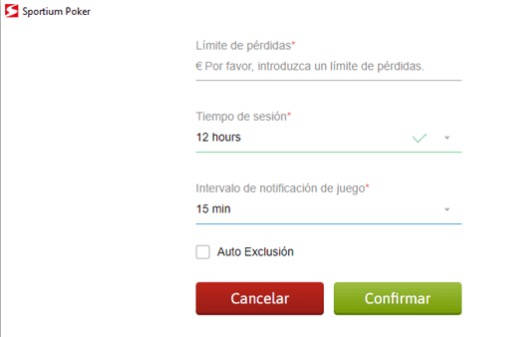
And just as the sporting reality may have played a key role (and one ignored in the Gaming Report and in its mentions in the media), a controversial measure forced poker players in 2024 to set login and session duration limits (equating the cash game poker format to slot games), which would also explain the significant drop in activity among operators offering online poker to their players.
Therefore, although the Ministry of Consumer Affairs (now integrated into Social Rights) used the data from the 2024 Gaming Report to describe the rise in players as alarming and has promoted a legislative amendment to once again prohibit these incentives (the Government is working to include the ban on welcome bonuses in the upcoming Customer Service Law), the reality is that beyond the bonuses, regulatory tightening remains one of the main characteristics of the sector.
Although recent press coverage has painted a scenario in which online gambling (players and spending) is significantly increasing, this Report and the reality of 2024 only serve to reignite the debate on the optimal regulation of the sector and highlight that, regardless of economic growth, it does not come at the expense of public health or safe gambling practices.
18+ | Juegoseguro.es – Jugarbien.es