The 2025 year-end review reveals an undeniable reality for the Spanish sector. Far from catastrophic predictions, the vertical is undergoing a structural transformation where historical leadership has changed hands and major operators are strategically shifting investment toward casino products. Facing a user profile that no longer seeks long desktop sessions, the industry stands at a definitive crossroads: either adapt the offer to the mobile, fast-paced consumption habits of modern entertainment, or risk seeing poker relegated to a testimonial niche.
The 2025 assessment of the online poker vertical in Spain calls for a measured and strategic reading. We are not facing a collapse or an “apocalypse,” as some isolated indicators might suggest, but rather an evident cycle change that has forced—and will continue to force—historic operators to make important decisions. We are referring to well-established operators such as
PokerStars or
888poker, present long before the 2012 regulation and which came to concentrate close to 90% of the regulated market in its early days, and which have had—or still have—to redefine their role within an ecosystem that in 2025 shows an unstoppable
Winamax and an
iPoker network gaining ground.
The main conclusion drawn from what happened in 2025 from a numerical standpoint seems clear: either poker accepts a residual role as a testimonial niche, or it improves its reinvention as a leisure product adapted to current digital consumption. It seems evident that the average recreational player no longer spends four consecutive hours in front of a laptop playing multi-table tournaments; today they prioritize short, intense, mobile sessions, integrated into their daily routine, in formats such as Spin & Go, Expresso, Blast, or Twistter, often from a smartphone and in between WhatsApp notifications and social media.
The good news is that—as we also develop in the following points—the ingredients are still present in Spain: sporting talent with media projection, well-established brands, and an online gambling market that, in global terms, continues to grow.
Quarters of decline and first signs of recovery
The data published by the Directorate General for the Regulation of Gambling (DGOJ) show a weak first half of 2025 for online poker, continuing the trend observed in 2024, especially since the introduction of session limits in cash game tables. For two years now, both cash games and tournaments (the two variants of the single “Poker” license granted by the Regulator) have lost relative weight within the main analytical metrics of licensed gambling in Spain.
However, the third quarter may have marked a turning point, with a recovery in the number of active players and in gross gaming revenue (GGR). More than a temporary rebound, this upturn seems to anticipate a new phase of stabilization, supported by fast formats, greater shared liquidity, and an offering more integrated with content and community.
How market share is distributed in 2025
Spanish online poker closed 2025 with only nine active operators, but with extreme concentration: two players clearly dominate the segment and make poker their main source of revenue and investment (
Winamax and
PokerStars).
From highest to lowest relevance, the estimated market structure would be:
- Winamax
- PokerStars
- partypoker (iPoker network)
- bwin (iPoker network)
- Sportium (iPoker network)
- Casino Barcelona (iPoker network)
- Betfair (iPoker network)
- bet365 (iPoker network, with a gradual withdrawal from poker)
- 888poker
Winamax and
PokerStars account for close to 80% of total traffic, supported by shared liquidity with France. In 2025,
Winamax reinforced its leadership to the point of being able to organize an online festival with €29 million guaranteed, a clear sign of strength and confidence in the product.
PokerStars, with its top series offering around €10,000,000 guaranteed, remains comfortably in second position, also supported by the liquidity provided by the Portuguese market (which
Winamax cannot yet access, as it does not hold a license in that country).
The
iPoker network as a whole would account for around a 15% market share, while 888poker would stand at around 5%, penalized by not having access to French liquidity (unlike its situation in Portugal).
Moving closer to or further away from casino: two opposing strategies
The strategic contrast between the leaders was one of the major axes of 2025.
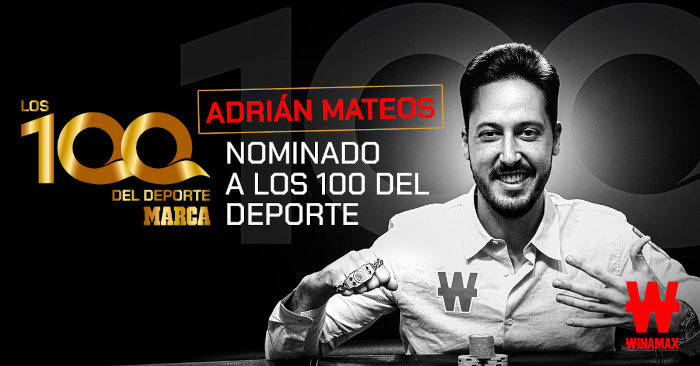
Winamax consolidated a hegemony based almost exclusively on poker, without a casino license and with a clear identity: brand, community, and sport. The use of ambassadors such as Adrián Mateos or Leo Margets made it possible to reposition “Spanish poker” through competitive success and credibility, while also contributing to the production of outstanding audiovisual content, with the successful and viral YouTube video series “In the Mind of a Pro.”
Adrián Mateos, winner of the “Sporting Achievement of the Year” award by Marca.com
PokerStars, by contrast, made it clear that poker is no longer its strategic priority. In line with its global approach, investment, product development, and communication have increasingly been directed toward casino, implicitly accepting a secondary role in the leadership of online poker in Spain. In fact, its main slogan is now “The Home of Gaming,” leaving aside the usual references to poker, which had been its flagship product until its acquisition by
Flutter Entertainment (owner of Betfair, Tombola, or SISAL, among others).
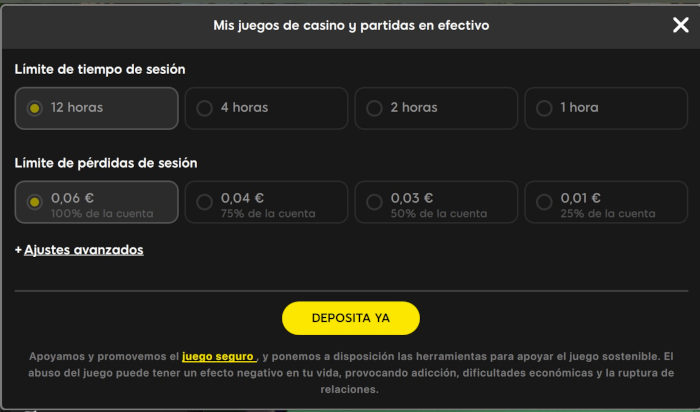
This shift was reinforced by the regulatory framework: since 2024, the regulator has required the establishment of time and deposit limits before playing and informational messages every 60 minutes, effectively equating poker with online casino, both in perception and in regulatory treatment.
Poker players in Spain must set time and spending limits in each session
iPoker regains weight in the Spanish market
The iPoker network regained relevance in 2025 thanks to an integration and volume strategy. The incorporation of historic brands such as bwin and partypoker in October 2025 strengthened liquidity and restored appeal to a network that had been losing prominence for years compared to “poker-first” operators and that, since 2012, had been made up of betting operators such as bet365, betfair or Sportium.
Its structural weakness remains the same: poker is rarely a priority for these brands, which limits the development of CRM, proprietary content and community. Nevertheless, supported by operators with a strong local presence such as Sportium and Casino Barcelona, iPoker managed to reposition itself as the third relevant block in the market.
However, with significant internal competition among its operators to attract the same players (who are offered rakeback and reload bonuses far above the sector average), the outlook for 2026 remains complicated, and it will be difficult for these brands to sustain a discourse based on “action and rakeback” if joint deposit limits are established, as suggested by the Ministry of Consumer Affairs.
Acquisition, retention or cross-selling?
From a marketing perspective, the diagnosis for 2025 and short-term forecasts also depend on the operator and its market position, although in general the picture appears worrying for the overall health of the segment. Online poker in Spain has fewer and fewer active players, lower retention, and above all has suffered fierce competition from products such as slots, casino and sports betting, with propositions better adapted to mobile consumption and fast entertainment.
Therefore, although the role of poker varies by operator, as we have already seen (for Winamax, it remains a main acquisition channel; for iPoker, sports betting is key to retaining and monetising the poker player…), looking ahead to 2026 it is expected that most operators (PokerStars, Sportium, bwin, partypoker, bet365 and betfair) will continue to view poker as a low-cost acquisition tool for casino or sports betting.
As long as the economic model is not rebalanced and traffic does not increase (which would mean improving guaranteed prize pools and poker promotions), it will be difficult to justify deep product investments. In fact, it would not be surprising if, as bet365 already did in November, poker were to even disappear as a highlighted category on the main website.
PokerStars has not forgotten what was once its core business, but as seen with casino-focused broadcasts in 2025 by one of its ambassadors (andyPSX), or with the recent signing of poker streamer “Kretyna,” who has shifted to streaming mainly slot sessions, casino content and promotion are more than a priority.
In any case, support for poker from Sportium or CasinoBarcelona appears guaranteed, with satellites and promotions that include the transition to live poker (the Sixers circuit in the case of Sportium, and the CEP and circuits such as the Catalunya Poker Tour or events held at the Barcelona city casino in the case of CasinoBarcelona.es).
Likewise, 888poker, despite its traffic decline, will host stops of its international circuit (888poker Live) and a new live poker circuit called “Noche de Poker – El Festival,” as well as maintaining brand ambassadors or team pros such as Lucía Navarro, El_Chur or Iñaki Angulo.
Content: from niche to digital mainstream
In 2025, Texas Hold’em content consolidated itself as one of the main visibility drivers for poker. Streamers, influencer tables, live tables from US casinos, broadcasts of cash games and high-roller tournaments such as Triton Poker, and live streams from any nationally relevant tournament transformed poker into consumable content, not just a gambling product. Appearances by media figures outside the sector—dozens of influencers and well-known internet personalities playing poker in productions with hundreds of thousands of views (Kiko Rivera, Cristóbal Soria, Guanyar, Viruzz, Ampeter, Spursito…)—expanded the traditional reach and lifted poker audiences to levels higher than the usual late-night roulette and casino programmes.
Major operators redesigned their funnels with a focus on community and entertainment, with formats such as La Timba by Winamax, Poker Night by PokerStars or Noche de Póker by 888poker. At the same time, sporting milestones strengthened the narrative: Adrián Mateos won his fifth WSOP bracelet (Event #11 of the online WSOP edition held in June), and Leo Margets broke a historic barrier by reaching the Main Event final table, bringing Spanish poker back into the global conversation and into mainstream media—the most natural gateway to online poker rooms.
Few product revolutions, but constant attempts
Poker remains a mature vertical, with little disruptive innovation beyond the already mentioned fast, three-handed jackpot formats (Spin & Go), which continue to sustain traffic and retention for many players. Only in a few cases was there the boldness to launch new products or formats (Winamax’s Space KO or the transition of Spin & Go formats into live poker tables).
This stagnation in the vertical shows that the problem is structural: the product is still designed for an “intensive,” banked player with time—an aspirational player who, in the pre-regulation era, sought to become professional through study, playing multiple tables and moving up stakes—whereas today’s consumer seeks short, simple and mobile experiences, integrated into entertainment and content ecosystems.
The reality is that taxation and the greater focus on products such as casino and sports betting have led many operators not to take the step of turning poker into a profitable product in its own right, aimed at a player who wants to progress, with clear learning paths and social leisure trajectories.
Live poker, in great shape
In contrast to online poker, live poker enjoyed excellent health in 2025. Circuits such as CNP, CEP or PokerStars festivals maintained intense schedules, with full rooms in Barcelona and Madrid and notable growth in locations such as Seville, Alicante, Murcia or Torrelodones.
Special mention goes to the CNP record, which for the first season featured Winamax as sponsor after more than a decade supported by 888. This change, thanks to Winamax’s traffic and resources, turned the CNP Winamax Madrid 2025 Grand Final into a record-breaking event in terms of participation in Spain, exceeding 2,650 entries in its Main Event.
Strategic conclusion: less noise, more structure
Online poker closed 2025 as a mature, stable and professionalised vertical. Without major headlines, but with a clear picture: absolute leadership by Winamax, strategic repositioning by PokerStars and a revitalised iPoker. The challenge is not rapid growth, but maintaining relevance in an ecosystem where other verticals capture more investment and attention.
Future leadership will not be built on one-off promotions, but on brand, community and strategic coherence. In that sense, 2025 left clear lessons for the entire sector.
18+ | Juegoseguro.es – Jugarbien.es