With none of the major sporting events that usually trigger spikes in investment and betting volume (World Cup or European Championship), 2025 has served as a year in which SPORTS BETTING operators relied on welcome bonuses, live streaming, branding, and a responsible multichannel strategy within regulatory limits in an attempt to increase their market share…
The absence of a FIFA World Cup or a European Championship (EURO) turned 2025 into
a year of strategic adjustment for the sports betting vertical in the spanish regulated market, forcing operators to rely less on occasional volume spikes and more on sustained acquisition, branding, and user activation within regulatory boundaries. A year that, in any case, will be remembered for having definitively lost its symbolic leadership, as the online casino sector in 2025 concentrates around 57% of online GGR, while sports betting loses relative weight in this key metric.
But reducing the sports betting vertical to its share of net gaming revenue for an operator would be to misunderstand everything. Fixed-odds betting products remain the strategic axis of the ecosystem: the entry point for most players, the main driver of visibility, and the natural territory for building brand narrative. And 2025 has confirmed exactly that. Users enter through sports, even though they increasingly monetize through other products.
In this context of growth without a major sporting event, it is worth highlighting that these have been 365 days with welcome bonuses available, high-profile international sponsorships, and many other circumstances that deserve to be analyzed in the following lines, looking at the year calmly and drawing deeper conclusions.
Welcome Bonuses in 2025: two dominant models
2025 has been the first full year in which the sector has been able to operate under the effects of the Supreme Court ruling that annulled several key articles of Royal Decree 958/2020 on commercial communications in the spring of 2024. In practice: the return of welcome bonuses, the reactivation of digital campaigns, and much greater freedom in content agreements with media outlets, influencers, and former footballers.
Promotional activity throughout the year has been concentrated around three major formulas, immediately recognizable to anyone who has browsed the main sports media outlets:
- Free bets of €100 to €200 after a first losing bet, almost turned into a universal wildcard to activate users, as used for example by bwin, Winamax, or William Hill.
- High first-deposit bonuses (100% up to €200 or even €300) with tough wagering requirements, sometimes combined with small “no registration” amounts or low-risk mini free bets. The option chosen by operators such as Luckia, Codere, GoldenPark, Betway, or 1XBet.
- Tactical reload bonuses to reactivate dormant databases or maintain user activity.
All of this in a competitive environment where bet365, Sportium, Codere, LeoVegas, or new entrants like DAZN Bet or revived brands like MarcaApuestas compete on product, odds, and streaming at practically the level of the major European leagues.
What is observable, however, is that from a marketing perspective the focus is no longer on squeezing users through bonuses and compulsive cash-outs, but on building long-term, profitable relationships that are compatible with the customer’s financial and emotional well-being. Moreover, those who fail to apply this approach will eventually clash with the new system of joint limits and with a regulator that will include explicit warnings in commercial communications throughout 2026.
Branding and sponsorships
If 2024 was the year of the headline “bonuses and betting operators return to Spanish sport” following the Supreme Court ruling, 2025 has been the year in which this trend consolidated into a strategic reality. The clearest example is
Luckia, which continues its agreement as an official partner of LaLiga in Spain, with campaigns such as “Where there is football, there is Luckia” and ads flooding television, social media, and digital channels.
This move is more than just a logo deal: it restores to the industry the idea that branding and institutional presence in major competitions are structural investments. At the same time, we have seen how operators with an international DNA have strengthened their commitment to global ambassadors, such as
bet365 and its sponsorship of the Champions League, or
Betfair, which signed
Luís Figo as the main face of the brand in Spain, with high-budget campaigns and activations such as “Club Betfair.”
Betway, meanwhile, brought in Thierry Henry as a global ambassador, fitting his figure into a total football, multi-platform narrative.
Sportium has also leveraged its sponsorship of Liverpool as its main brand advertising reference.
We also highlight the case of bwin, which returned to the Bernabéu on the occasion of the NFL Madrid Game 2025, the first official NFL game in Spain, played between the Miami Dolphins and the Washington Commanders last November, with a rebranded Santiago Bernabéu dressed almost like a Super Bowl venue.
bwin was highly active in content and cross-promotions between football and the NFL, leveraging its status as a strategic partner and sponsor of the NFL in Spain and Germany.
All of this deployment has a clear consequence: branding gains weight over tactical promotion and becomes the emotional glue between the brand and the sports fan.
Affiliation and media
The long-established major affiliates in Spain
have continued expanding into Latin America, while also making a qualitative leap in product and strategy. Projects such as Casasdeapuestas.com, apuestas-deportivas.es, Sportytrader, Oddschecker, among others, have consolidated their positions in reviews, bonuses, and reference odds comparison, with reviews of most regulated operators, real-time odds comparison tools, and content that increasingly resembles the work of a traditional sports media outlet.
Tipsters, meanwhile, have continued to dominate “emotional” affiliation through Telegram, X, and other social networks. Rankings of “best tipsters,” subscription models, and private communities coexist with CPA and revenue share agreements that are difficult to track from the outside.
Added to this is the role of operators themselves as disguised media outlets. Corporate blogs featuring match analysis, betting guides, and competition previews (EuroLeague, UFC, NFL, etc.) compete for SEO with major sports newspapers, while organic positioning and paid advertising remained in 2025 a strategic battlefield, as is typical in mature markets like Spain.
Casino cross-sell becomes normalized
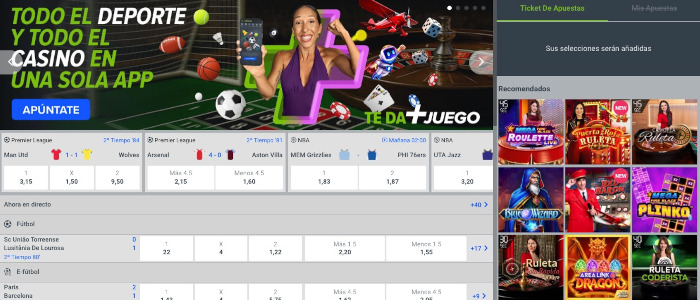
If there has been a silent but profound change in 2025, it is the full normalization of cross-sell between sports betting and casino. Just a few years ago, sportsbook users navigated a relatively “pure” sports environment; today, most websites and apps integrate live roulette banners, direct access to specific slots, and even dynamic promotional modules within the betting slip itself.
The key concept here is LTV (lifetime value), which in the sector refers to the total value a player generates throughout their relationship with the operator, net of costs and promotions. The challenge is no longer to push users to deposit more each month, as the regulatory space tightens, but to keep them active for longer, using more products, and doing so within stable and healthy gaming patterns. Therefore, a fundamental objective becomes the percentage of players who migrate from sports betting to other categories within the casino vertical (mainly live casino and slots).
The obvious risk is that the pendulum swings too far toward casino and degrades the sports fan experience: too many commercial impacts, too many interruptions, too strong a feeling of “I brought you in with an El Clásico bonus, but what I really want is for you to play roulette.” If the sports betting vertical loses its authenticity, the damage to the brand may not be fixable with a couple of free spins.
The definitive rise of In-Play
Live betting continued to be one of the main activity drivers in 2025, with quarterly growth rates exceeding 30%, boosted by high-consumption events such as the 2025 Champions League final. Live betting confirmed itself as the format that maximizes engagement and frequency, leading operators to keep investing in offering the widest possible range of live events, ideally with streaming and visual feeds.
At product level, the year stood out for the explosion of player performance markets—goals, shots, assists, passes, rebounds, rushing yards—and the use of advanced statistics to change player consumption habits (from betting on over/under 3.5 total goals to shots on target, total attempts, possession percentages, etc.). The availability of advanced data such as Opta, integrated in real time, enables the construction of increasingly sophisticated and personalized prop bets.
On this foundation, the year also consolidated several additional product trends:
- advanced cashout options, allowing users to secure profits while the event is ongoing
- increasingly deep bet builders, enabling users to build their own match narratives (“Barcelona to win + Lamine Yamal to score + over 2 corners per team”)
- multipliers and enhanced odds as seasoning, not as standalone products
- pools and prediction contests tied to full matchdays
- a stronger layer of “insurance,” such as refunds if your team loses in the 90th minute or had taken a two-goal (or 17-point in basketball) lead
Beyond men’s football
Although football continued to account for close to 70% of activity, 2025 showed sustained growth in other sports, bringing more tangible diversification than in previous years. Tennis and basketball maintained their role as secondary pillars, driven by highly attractive figures such as Carlos Alcaraz or the EuroLeague 25/26 season, which many operators supported with dedicated content and highlighted odds.
UFC and boxing leveraged figures such as Ilia Topuria to gain presence in schedules and segmented campaigns. But the most interesting movements came through two channels: the arrival of the NFL in Madrid, “pop” betting (Eurovision, Kings League, La Velada del Año…), and the expansion of esports markets. None of these sustain the business on their own, but they do help position the brand as a total entertainment company, not just a professional sports betting operator.
At the same time, some segments lost prominence. Virtual sports, for example, have ceded mental space to increasingly rich live experiences and a rapidly expanding online casino.
Strategic conclusion 2025
When all the pieces are put together, the message of 2025 is quite clear: the sports betting vertical is no longer—only—a business of odds and accumulators; it is the axis around which the strategy of almost any relevant operator in the Spanish market revolves. In a year without a major national team tournament, sports betting has demonstrated that its value goes far beyond direct GGR.
Looking ahead to 2026, growth will be threatened by measures such as upcoming joint deposit limits or mandatory “tobacco-style” warning messages in advertising, but the real question for operators is not how much more can be invested in advertising or bonuses, but what kind of sportsbook they want to build. One that is purely transactional, designed to maximize short-term extraction under increasing regulatory risk. Or one that uses the enormous drawing power of sport to offer responsible, sustainable, and credible entertainment experiences in the eyes of regulators, media, and society.
18+ | Juegoseguro.es – Jugarbien.es