CNMV or DGOJ? Predictive markets open a new regulatory frontier in Spain
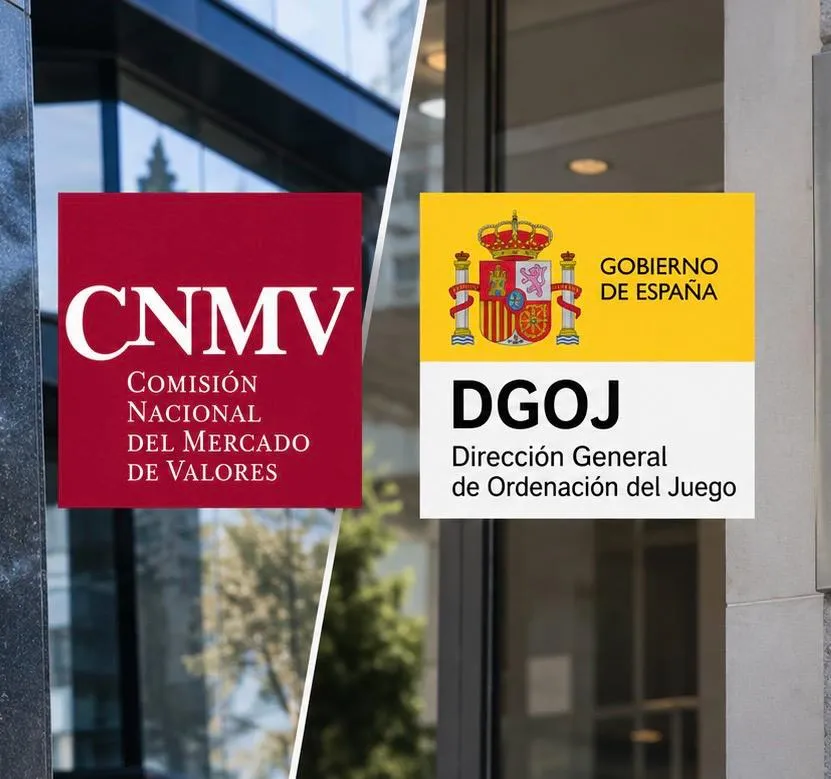
The international rise of predictive markets raises a particularly relevant question for Spain: are they financial products that should remain under the orbit of the CNMV or bets subject to the regulation of the DGOJ? Europe has already warned that the answer depends on how each product is configured.


The signing on Monday of the agreement between the CNMV and Autocontrol to strengthen the control of digital financial advertising comes at a particularly interesting time. There is no indication in the agreement that it is specifically related to predictive markets, but the phenomenon of prediction markets has already entered the radar of European financial supervisors. And it poses a particularly sensitive frontier for the gaming industry.
International platforms currently allow contracts to be negotiated linked to the outcome of future events: from elections and political decisions to economic, sporting or social events. The user takes a position on whether a certain event will occur and the value of the contract evolves according to the probabilities that the market attributes to that outcome.
The seemingly simple question of "betting" on something happening thus becomes a considerably more complex legal problem. ESMA has already warned about event contracts.
The European Securities and Markets Authority (ESMA) expressly addressed this issue in July 2026 by reminding companies of existing obligations in respect of certain event contracts. The European supervisor considers that some of these products may have the characteristics of a derivative financial instrument.
Of particular importance is the case of contracts with a binary outcome – yes/no, happens/doesn't happen – which may fall under the existing European restrictions on binary options. But ESMA also introduces a consideration of enormous importance for the gambling sector: depending on their characteristics, these contracts can also be considered bets under national legislation.
There appears the Spanish question. CNMV or DGOJ? If a predictive market is legally a financial instrument, it would fall within the scope of the National Securities Market Commission and financial legislation. If, on the other hand, the product meets the legal characteristics of a bet, the issue shifts to Law 13/2011 on the regulation of gambling and to the competences of the Directorate General for the Regulation of Gambling (DGOJ) when it comes to a state-wide activity.
The border is not smaller. It determines who authorises or supervises the operator, what requirements they must meet, what advertising they can carry out, which consumers they can target and what sanctioning regime is applicable. And there is a third particularly interesting possibility: that the expansion of new digital models forces us to analyse products that are precisely located on the border between the two regulatory worlds. An issue that goes far beyond Polymarket.
The extraordinary international growth of predictive marketplace platforms has turned a category that until a few years ago was a minority into an issue that regulators can no longer ignore. But the regulatory debate should not be limited to a specific platform.
The underlying question is what happens when a product technologically presented as a "market" allows the consumer to commit money on the uncertain outcome of a future event. The trade name does not in itself determine its legal nature. Precisely for this reason, ESMA has focused on the specific characteristics of each contract. At the same time, Spain is strengthening its vigilance over digital promotion.
In this scenario, the agreement signed on September 15 by the CNMV and Autocontrol is of special interest. The agreement will strengthen cooperation on advertising of investment products and services and pays special attention to new digital environments, social networks and the so-called finfluencers. It cannot be said that this agreement specifically anticipates the entry of predictive markets in Spain. But it does show that the supervision of new financial products and their digital promotion is gaining weight, precisely when Europe is beginning to delimit the regulatory treatment of prediction markets.
For the Spanish gaming sector, a question is thus opened that will probably become increasingly important: when the predictive markets definitively knock on Spain's door, will they be entering the territory of the CNMV or that of the DGOJ? The answer will depend less on what the product is called and much more on how it is legally constructed and what the user is actually buying.