Bulgaria bans gambling advertising but saves sports sponsorship: the project reaches the European Commission
Brussels receives a new Bulgarian text that vetoes gambling advertising and toughens fines.


Bulgaria has notified the European Commission, on October 15, 2026, of a new draft law amending and extending the Gambling Law, registered as 2026/0558/BG in the European Union's technical notification system. The text prohibits gambling advertising in any format, eliminates affiliate licenses, allows websites and social networks to be blocked, and increases fines. At the same time, it maintains sports sponsorship.
The notification opens the three-month standstill period set out in Directive (EU) 2015/1535. During that period, the Commission and the other Member States may submit reasoned observations or opinions before the text is adopted.
The project comes in the midst of a transformation of the Bulgarian market, which we at Infoplay analysed in depth in August: Bulgaria revolutionises online gambling: it licenses affiliates, blocks payments and exceeds 66,900 million in bets.
Total prohibition, with assessed exceptions
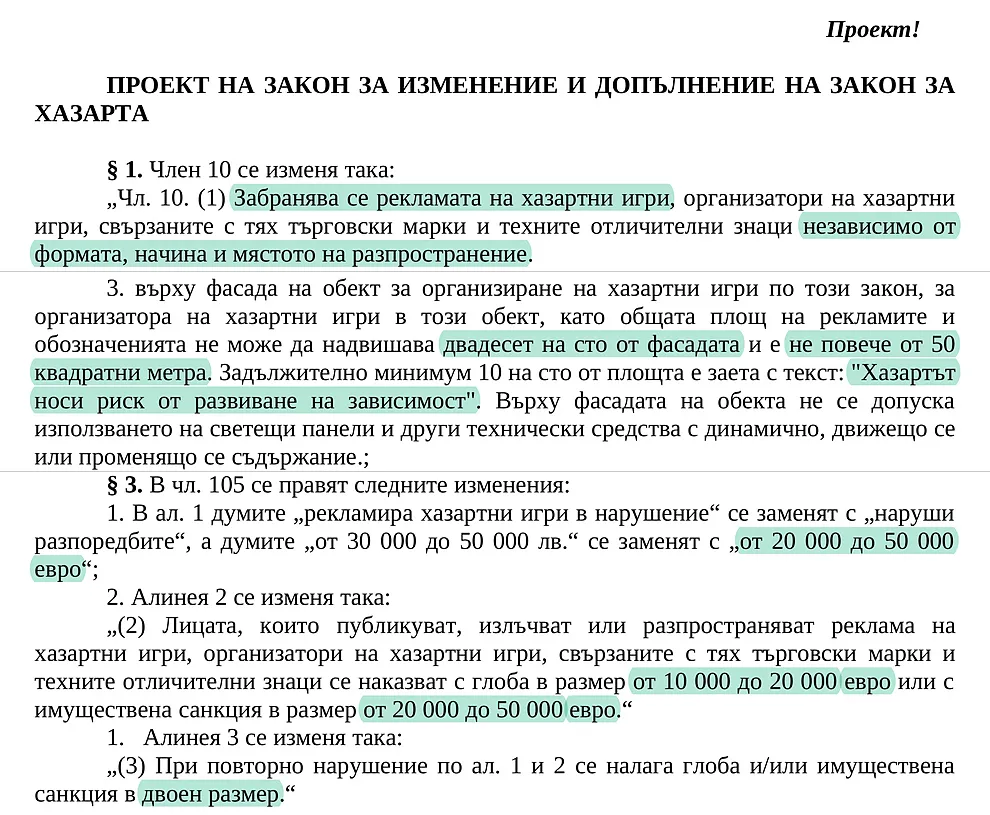
The new Article 10 prohibits the advertising of games of chance, gambling operators and their trademarks and distinctive signs, "regardless of the form, mode and place of dissemination".
The ban has four exceptions. The first is the information that the operator publishes on its website and on licensed premises, whenever it is necessary to organize the game and participate in it. The second is the broadcast of the draws of the public company Bulgarian Sports Totalizer, the country's state lottery, and the announcement of its prizes.
The third is the facades of gambling premises, with strict limits. Signs and advertisements may not occupy more than 20% of the façade or exceed 50 square metres. At least 10% of this surface area will have to carry the warning "Gambling carries a risk of developing addiction". Nor will luminous panels or screens with dynamic, moving or changing content be allowed.
The fourth is sports sponsorship: the brand may appear on kits, facilities, pavilions, stadiums, swimming pools and materials of federations and clubs. Any kit or product designed for minors is excluded.
In all these cases, only the registered trademark of the operator may be displayed and, in sponsored events, also its company name.
Sponsorship survives, but without virtual advertising
Licensed operators will be able to continue to sponsor licensed clubs, federations and sports organisations, as well as events in support of culture, health and education. The websites of those sponsored will be able to display the operator's brand or name.
The text does, however, put a limit on broadcasts. On television or on the internet, the sponsor's brand cannot be added electronically or digitally if they are not physically in the venue. In other words, the door is closed to virtual advertising at matches.
For the Spanish reader, the difference with the national model is clear. Royal Decree 958/2020 on commercial communications of gambling activities prohibited sponsorship on shirts and the sale of the name of stadiums. The Bulgarian text, on the other hand, maintains the presence of brands in sport.
Media surveillance and blocking of websites and social networks
The project tasks the Electronic Media Council, Bulgaria's audiovisual regulator, with policing the media space. If it detects violations, it will have to pass them on to the National Revenue Agency, which oversees gambling in Bulgaria.
The agency may order the suspension or blocking of websites, mobile applications, profiles on social networks and video and streaming platforms that advertise the game, the operators or their brands. This is a new wording of blocking powers that the Tax Administration had already extended this summer, as we reported in Infoplay.
End of affiliate licenses, two months after its premiere
The reform removes from the agency's powers the granting of licenses to promote gambling through affiliates, so that figure disappears from the law. It is a license that affiliates who attract players in exchange for commissions have needed since August 2026.
The text also adds deposits to one of the sections that already mentioned simultaneous gaming sessions. And it extends another, which until now referred to betting, machine games and casino games.
Fines of up to 50,000 euros, and double if you repeat offences
The sanctioning regime is updated to the euro, Bulgaria's official currency from January 1, 2026. Operators who fail to comply with the rules will face fines of 20,000 to 50,000 euros. Until now, it was punishable by between 30,000 and 50,000 leva, and only illegal advertising.
For the first time, anyone who publishes, broadcasts or disseminates advertising is also sanctioned. Individuals will pay between 10,000 and 20,000 euros and companies, between 20,000 and 50,000 euros. If they reoffend, the penalty is doubled.
A text different from that of the Government
This draft is different from the draft that the Ministry of Finance put out for public consultation on September 23, which is open until October 23. On that day, Prime Minister Rumen Radev announced a total ban on gambling advertising. The government's text was notified to Brussels on October 2 with the number 2026/0536/BG and, in addition to the advertising veto, includes fiscal measures: the variable rate on online gambling would rise from 20% to 21% in 2027 and 22% in 2028, with a minimum of 100,000 euros per month per operator.
The text notified on 15 October is much shorter. It only amends three articles, on advertising, agency powers and sanctions, and does not include tax measures. Earlier, in September, two opposition parties, We Continue Change and Democratic Bulgaria, had submitted their own proposals to the National Assembly to ban gambling advertising altogether.
The debate coincides with a time of greater organisation in the Bulgarian sector. Its employers' association, the Association of Organisers of Games and Gambling Activities of Bulgaria (AOGGAB), together with the Serbian AGOS , promoted the creation of the Balkan Gambling Federation, which in October elected its first president.