In Spain, the DGOJ data leaves no room for doubt: the casino vertical, driven by live roulette and slots, continues to boast outstanding annual growth. Despite evident promotional restrictions, in 2025 it definitively surpassed sports betting in terms of market share.
In this analysis, we delve into the key insights that the general DGOJ figures do not reveal...
While the industry was focused on the controversial conflict between
Playtech and
Evolution, both operators and players in Spain ultimately benefited from this battle, as new formats from both providers were incorporated and consolidated, driving audience acquisition in 2025. These two giants were forced to continue innovating and to bring their competition for leadership in the live roulette product (which grew in every quarter of 2025) and in the increasingly popular “game shows” to the Spanish market.
In terms of figures and relevance within the
CASINO vertical, 2025 can be summed up in a single sentence: the year in which casino definitively consolidated its lead and, without the need for major commercial effort, established online casino as the main gambling vertical in Spain, overtaking sports betting in market share not due to a temporary effect, but as a result of a structural shift based on product, innovation and the ability to adapt to a restrictive regulatory environment.
Online operators expand their casino game offering
What the DGOJ data confirm (and what they do not)
The official data published by the Regulator in 2025 show solid annual growth for casino, driven mainly by slots and live roulette, with consistent quarter-on-quarter advances throughout 2025. However, these figures only reflect the regulated market and leave out key dynamics such as the impact of illegal gambling and player acquisition through social platforms, which will also represent a challenge looking ahead to 2026, as we will explain in the following lines.
In terms of GGR (gross gaming revenue), casino and slots licences now account for close to 60% of the total in Spain, with sports betting in second place (36%), poker (6%) and bingo (1%). There is a clear decline in the relevance of traditional roulette (perceived as slower and more boring in light of new trends focused on speed and multiplier-based payouts) and blackjack (which has yet to incorporate a live format in our market). Meanwhile, slots are up by 25%, supported by mainstream titles from major providers as well as by customised and localised products such as those offered by
MGA Games, which are capable of leading promotional campaigns over long periods at any operator, making it easier for casinos to maintain consistency in content and gaming offer.
Live roulette boom
Supported by attractive multipliers and the increased involvement of real croupiers in roulette games—who have evolved into entertainers and hosts of additional bonus games—live roulette has moved away from being a classic game of probability and betting to become a form of entertainment. The success of
Mega Fire Blaze or
Quantum by Playtech, and
Lightning Roulette by Evolution, leaves no room for doubt: these have been the most visible products in operators’ portfolios throughout the year, often starring in cross-selling campaigns from sports betting or poker sections.
Looking ahead to 2026, traditional roulette with a 35:1 payout is expected to continue losing appeal in favour of new formats that introduce speed, multipliers and “big prize” narratives.
Live roulette has evolved into an emotional and dynamic product, closer to spectacle than to the classic casino game. A recent title seeking to compete with Mega Fire Blaze is Evolution
Red Door Roulette, which pays only 20:1 on straight-up bets and has been gaining popularity in recent weeks thanks to the multipliers featured in its bonus game. In this extra round, the presenter spins a virtual roulette wheel in a fantasy-style visual environment when the ball lands on one of the numbers with an additional multiplier prize.
Multipliers, speed and “big win” logic are no longer the exclusive domain of
Playtech (Quantum) or
Evolution (Lightning). The introduction of multipliers and high-volatility mechanics has also been adopted by brands such as PokerStars, bet365, bwin and betfair, transferring their “spin” format into live casino. This has resulted in more intense sessions, higher engagement, and a value perception based on instant big wins rather than on pure mathematical return.
Evolution–Playtech competition as a driver of innovation
We have already mentioned game shows and live roulette, the two flagship specialities of Evolution and Playtech, which in 2025 continued to be the leading providers, despite being embroiled in a legal and reputational conflict stemming from a report produced in 2021 by private intelligence firm Black Cube. The report accused Evolution of supplying live casino games to operators serving restricted or sanctioned markets. This information reached regulators, triggering investigations and causing a drop in the company’s share price.
In 2025, the conflict escalated when Evolution filed a defamation lawsuit, claiming that Playtech was behind the commissioning and dissemination of the report, an allegation that has affected Playtech’s share price and credibility in recent months.
This battle for leadership in live roulette accelerated the arrival in Spain of hybrid game-show-style formats. In 2025, products such as Mega Fire Blaze Roulette (Playtech), Red Baron Live and Red Door consolidated their position, confirming what had already been observed in other markets: total immersion and the transformation of the casino into a live spectacle are the major trends. As a result, online casino has fully embraced streaming logic, with presenters, pacing, narrative and design conceived to be consumed as content. The gaming session has become an immersive experience rather than an individual and private act, as also demonstrated by the strong reception of Evolution’s “First Person” product line.
Slots in 2025: less volume, more personalisation
Although connected slots and jackpot games continue to improve the user experience—evolving from games that offered passive accumulators into genuine entertainment content—in 2025 progressive jackpots ceased to be a differentiating factor and became secondary to a new trend: fully customised hit slots featuring the operator’s name or proprietary brand elements.
This is a reality we have been seeing for years in live roulette (with exclusive, operator-branded tables and croupiers), but in 2025 it definitively moved into online slots as a central part of the experience offered by operators.
We believe that in 2025, personalisation replaced the bonus as the main competitive lever in slot sections, where quantity had traditionally prevailed over quality.
Crash games: Aviator showed the way, but did not relinquish leadership
The success of
Aviator consolidated a new category within slots. In Spain, Codere capitalised on this trend particularly well, leveraging
Spribe’s hit game to drive growth over the past three years. And while the industry has seen numerous attempts to replicate its success, no one has managed to displace Aviator from its dominant position in the crash games segment—not even in 2025.
In fact,
Sportium has recently introduced it to part of its player base, and
bwin has positioned it as one of its major launches at the end of the year.
One of the most solid attempts has just launched in Spain at the hands of Evolution, which has already made
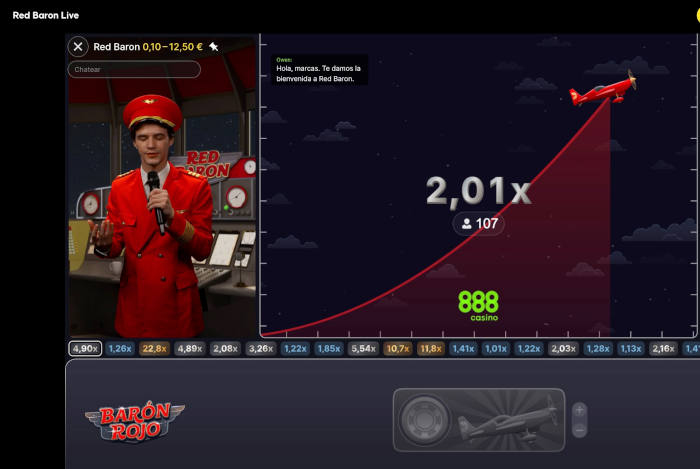
Red Baron available to most major “.es” operators. The game, both in its standard version and in its “game show” version (with a presenter), is expected to strengthen the crash games segment, which already features around a dozen well-established titles in Spain, including products from
Pragmatic Play (Spaceman or High Flyer) and
Playtech, among many other providers.
Evolution’s Red Baron with presenter at Spanish operators
Streamers and promotion at the edge of regulation
Leading GGR and being the most profitable product for most operators throughout 2025, casino promotion through streamers ceased to be marginal and became professionalised, often operating from jurisdictions such as Andorra. Content creators on Twitch, Kick, YouTube and TikTok consolidated their role as acquisition channels in a grey area between entertainment, influence and advertising.
However, many of these content creators, high-profile accounts and social media ads also served as a gateway to illegal gambling. In fact, in the last quarter of 2025, a study carried out by Jdigital and EY confirmed the worrying situation of the sector, which is seeing how the attractive offers of unlicensed operators continue to fuel illegal gambling.
Indeed, influencers and affiliates in Spain—who for years have led casino player acquisition—have been promoting and counting as partners illegal operators such as Locowin, which has almost certainly enjoyed a 2025 with more registrations and depositors than most regulated Spanish operators that pay for their licence.
Social platforms (Facebook, Instagram, TikTok) and messaging apps such as Telegram and Discord have become the main exposure channel for unregulated gambling, especially crypto casinos, but also .com operators offering Spanish-language content and promotions targeted at the local market. This reality is particularly evident in CASINO and undoubtedly puts strain on the regulated model, which competes at a disadvantage against ecosystems without restrictions.
Strategic conclusion 2025
What was experienced in 2025 was unusual, as for much of the year the industry expected further restrictions on commercial communications and the disappearance of welcome bonuses and advertising outside the operator’s own “Promotions” section. This situation prevented operators from having the confidence to make long-term investments, always facing the possibility of a scenario similar to the immediate post-pandemic period.
However, following the Government’s failed double attempt (first through the project to launch the State Public Health Agency, and later through the Draft Law on Customer Service) to reintroduce the clauses of the “Garzón Decree” that were annulled by Supreme Court Ruling 527/2024 in April 2024, the market moved forward and was at least able to invest part of its time in preparing for what may come in 2026, in the form of joint deposit limits or the introduction of explicit warnings, similar to those used in tobacco advertising.
In any case, casino growth in 2025 was driven by innovation and experience design, not by promotional investment. It was also supported by the fact that many Spanish operators are already active in Latin American markets, where trends can be anticipated and safer bets can be made, as has been seen with several slot categories, crash games and titles such as Plinko. Alongside live roulette and new formats, these products continue to shape an “entertainment-first” model that is clearly here to stay.
18+ | Juegoseguro.es – Jugarbien.es