CSR BREAKFAST AND RESPONSIBLE GAMING with E-GAMING SPAIN ONLINE and COMAR: "The regulated sector will probably not copy predictive markets, but it will start to resemble them"
Part 2
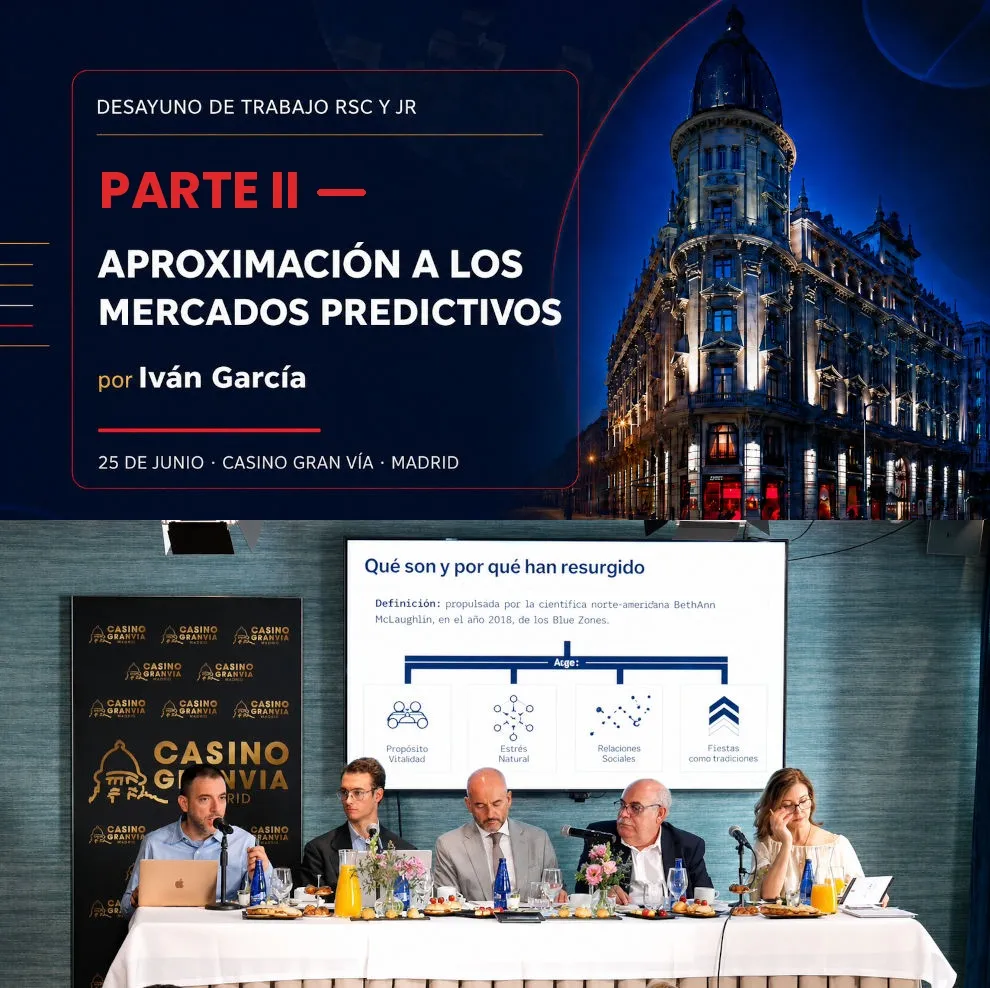
In the second part of his speech during the CSR and Responsible Gaming Working Breakfast "Two speeds, one responsibility", held at the Casino Gran Vía COMAR with the sponsorship of E-Gaming Spain Online, Iván García López delved into the mechanisms that explain the growth of predictive markets and the risks that their expansion poses both for users and for the integrity of these products.


The round table on predictive markets and artificial intelligence within the framework of the Working Breakfast on Corporate Social Responsibility and Responsible Gaming, held at the Casino Gran Vía, was inaugurated with such a relaxed tone by the moderator of the meeting (Ramón Cubián Martínez, General Director of Land and Head of Gaming of the Community of Madrid), opening the session with humour, but setting a firm position that would condition the debate: "these markets do not fit into the regulations of either Spain or the Community of Madrid".
As he explained, part of the success of these products lies precisely in their ability to approach or move away from the traditional terminology of the game depending on the context. Platforms such as Polymarket and Kalshi prioritize concepts such as prediction, information, market, price or probability, and present themselves not as bookmakers but as mechanisms capable of aggregating the dispersed knowledge of thousands of participants; a form, in short, of recreational speculation about future events. García López was clear in clarifying that the activity of forecasting is not new – neither are political betting, Eurovision markets or cross-bets between users, a model that has been operating in an authorized way in Spain for two decades with the help of Betfair Exchange – but that the real novelty is in combining these already known elements with the aesthetics of trading. the crypto infrastructure and digital culture of Silicon Valley. Compared to the conventional bookmaker, where the user selects an odds, the predictive market invites him to take a position that he can hold, buy at a certain price or sell before the event is resolved, bringing the product closer to the operation of a financial terminal in which the volume, liquidity and price evolution weigh as much as the negotiated question.
The speaker related this design to the emergence of a new audience formed in Bitcoin, memecoins, NFTs, financial options and trading communities on Discord, for whom the boundaries between investment, speculation and entertainment are much less clear than for the traditional customer of a bookmaker. He gave as an example the access to Polymarket itself, which – until its recent blocking in Spain – dispensed with the conventional registration of a regulated operator and was based on the direct connection of a cryptocurrency wallet, which simultaneously functions as a means of payment, identification and gateway to the product. The result, he said, is a new user profile accustomed to financial interfaces and real-time graphics, for whom economic risk is presented as a form of analysis or participation rather than as a bet.
García López warned that this transformation is not limited to technology: it also reaches the language of advertising. Kalshi and Polymarket have opted for campaigns on general television, social networks, content creators and everyday spaces, far from the iconography of the casino and closer to that of a financial or technological platform. This choice modifies the perception of the user, who does not necessarily receive the message that he is entering a gaming environment, but that of consulting information or negotiating a probability. For the rapporteur, this semantic shift – which does not eliminate economic risk, but does reduce its social identification with gambling – is one of the most relevant issues that operators and regulators will have to face, insofar as two functionally close activities may end up competing under completely different obligations and advertising channels.
The first major risk pointed out by García López was not technical or legal, but philosophical: the promise that any event – an election, a war, a judicial decision, a cultural controversy – can immediately become a market clashes with the discourse that European regulated gambling has built for years around controlled leisure and player protection mechanisms. This permanent availability is in direct tension with policies already consolidated in Spain, such as the restriction on depositing money once a sporting event has started to bet live, measures developed after years of analysis of player behaviour that predictive markets radically compress by being able to react to news almost in real time. The speaker compared this speed with that of other online gaming products – crash games or Aviator, which took years to consolidate and be understood by operators and regulators – compared to predictive markets that simultaneously develop product, audience, financing, communication and regulatory conflict.
The expansion of the catalogue to include politics, economics and geopolitics also introduces integrity risks that do not appear with the same intensity in sport, where there are rules, referees and data providers such as Opta to refer to. García López and several attendees mentioned scandals of users with possible privileged information in markets about international conflicts and political decisions, in which the advantage does not come from a better reading of public data but from early access to a decision or the ability to influence the event itself. The speaker took this logic to a revealing extreme by citing games – developed mainly in crypto casino environments – connected to real traffic cameras, where the user predicts how many vehicles of different types will pass through a street in the following minutes: a sign, he pointed out, that sport is no longer essential as soon as a sign is available. rules and an audience willing to speculate.
The problem of establishing what has really happened was illustrated by the open market on whether Ukrainian President Volodymyr Zelensky would wear a suit at a public event after his meeting with Donald Trump at the White House. The question moved tens of millions of dollars, and the dispute ended up focusing not on the prediction but on the exact meaning of the word "suit", in the face of formal clothing that did not clearly respond to the conventional definition. García López contrasted this episode with sport, where despite the existence of specific disputes there is always an official source of resolution, compared to certain predictive markets whose resolution depends on decentralized mechanisms linked to tokens and blockchain, in which the participants with greater economic weight can influence the validation of the result. The risk, he insisted, is not only in asking controversial questions, but in creating large volume markets without having first established an unequivocal rule to solve them.
Asked by the moderator about the fit of these platforms in Spain and Europe, García López was blunt: the complete Polymarket or Kalshi model has no place in the Spanish regulatory framework, built on authorized operators, player contracts, identity controls, resolution rules and responsible gaming mechanisms. He clarified, however, that many components of the product are not alien to the sector: in Spain there are already licenses on non-sporting events and the figure of cross betting, popularized for years by Betfair Exchange. What is disruptive, he said, is the combination of all these elements — crypto access, permanent trading, liquidity, early sale of positions, thematic breadth, financial marketing and accelerated market creation — and not each component separately.
The speaker added that large US operators, far from standing still, have already begun to observe and incorporate predictive market mechanics: he cited the cases of FanDuel, DraftKings and Fanatics, proof that the threat does not come only from Polymarket and Kalshi but from the possibility that the entire industry will progressively adopt their logic. supported by a financial and cultural infrastructure associated with Wall Street and Silicon Valley.
García López closed his speech by pointing to one last dimension of the model: the value of the data generated by these markets. When thousands of people risk money to express what they think will happen, the resulting price can be read as an aggregate measure of expectations, with potential value for financial institutions, media or analysts — a comparison, he said, to the role providers like Opta or Sportradar play in sports today, and a possible explanation for why still-loss-making companies reach very high valuations. Their final conclusion was that the European regulated sector will probably not reproduce the American model, given the legal and cultural differences, but it will have to face its consequences: sportsbooks with interfaces closer to trading, greater prominence of data and more granular markets, and regulators forced to deal with products that blur the boundaries between betting, Financial contract, digital asset and information.
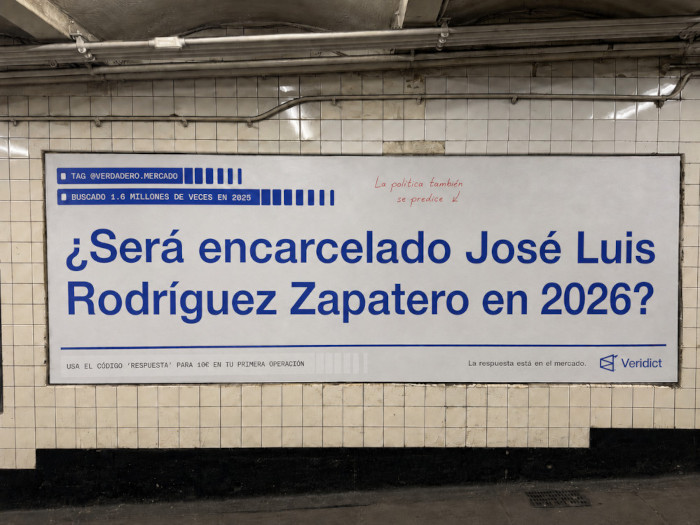

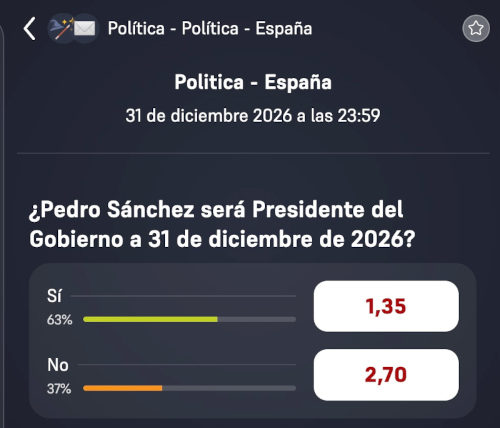
For García, the phenomenon should not be analysed only by asking whether Polymarket or Kalshi will be able to operate in Spain. The strategic question is what changes are they introducing in the perception of users and what part of that transformation will end up filtering down to conventional gambling.
His final message was that predictive markets don't just change the betting catalog. They alter the speed with which the product is created, the way it is presented, the profile of the audience, the value attributed to the data and the relationship between information and speculation.
The European sector will probably not see an exact reproduction of the American model. But he will have to face its consequences.